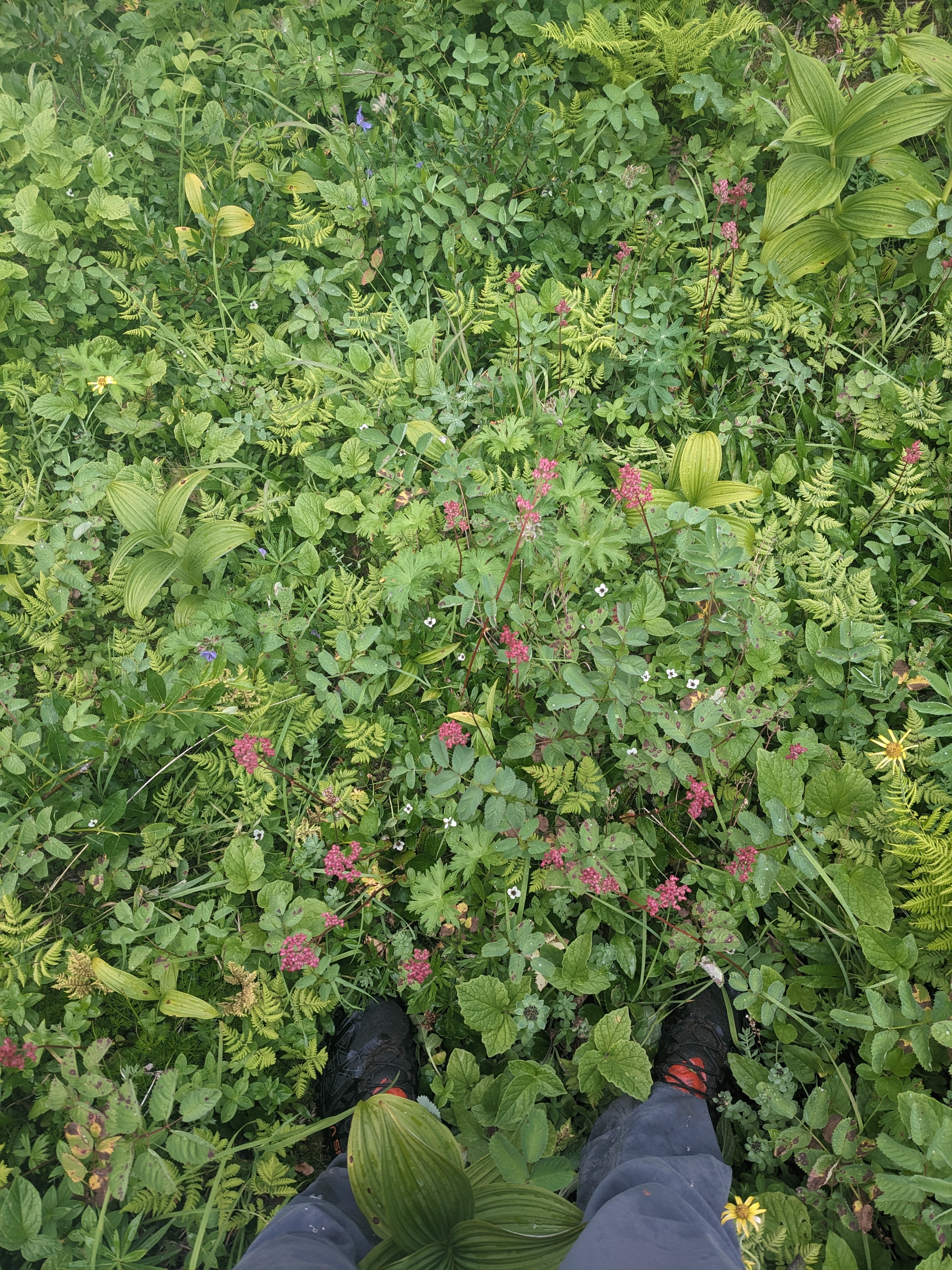
Ouachita Trail (October 14-22, 2023)

I hiked the Ouachita (“Wash-i-tah”) Trail on what might be called a whim. I’d wanted a week to myself and didn’t want to do much planning. I’d never been to Oklahoma or Arkansas and the weather looked better there than in Anchorage in the fall (the going wisdom in Anchorage is that if you went on vacation from Thanksgiving to Valentine’s day, you wouldn’t miss much). I was hoping to catch some fall colors as I’d been recovering from illness while colors changed at home. While pleasant and possessed at times of a calming beauty, my rushed walk lacked views and was beset with minor drama including the failure of most record keeping devices. I even left the maps which I’d been annotating with experiences and events on the airplane home. What’s left here is hastily reconstructed from memory and decorated with the few pictures from the cheap replacement phone I was able to pick up with help from a Lori, the angel in the tiny town of Story, two whom I’m deeply grateful.

I’d first heard about the Ouachita Trail on an episode of Backpacker Radio which I don’t really remember but rediscovered it when scanning Wikipedia’s list of long trails in the US, looking for something which would take about a week. For navigation, I printed ouachitamaps.com for topo maps on standard 8.5’x11′ instead of the recommended 11’x17′ and brought Bill Mooney’s data book for water and mileage markers. I didn’t read much about the trail besides this Treeline Review article. For resupply and logistics, I reached out to to Michael and Lori on FoOT’s Shuttle List (isn’t “FoOT” the best name for a trail related organization?). I checked the average weather for October and November and the 10 day forecast when that became available to decide how little gear I could bring (sunny & dry + trees + shelters –> poncho tarp!). More and better research wouldn’t have hurt but wasn’t necessary either. It’s fun to leave some things up for discovery.

Saturday, October 14, 2023

  • Passed the rock garden shelter. “Rock garden” is an appropriate name. A light pack helped.
  • Lost the trail a few times and had to search for up to ~3min, typically in places where it crossed a rock field or drainage and natural formations in the terrain mislead me on the other side. Blazes were very helpful but not always where I needed them most.
  • Slept at Holson Vista shelter
    • Vista was blocked by trees
    • A tarp was conveniently placed over the open side of the shelter to block the continuous wind.

Sunday, October 15, 2023

  • Water from Horse Thief Spring. Lower basin was clear. Upper basin was disgusting.
  • Lots of ankle rippers. These are thin, low vines full of thorns which like to throw a branch out over the trail like a snare about ankle height. The worst is when vines from opposite sides cross because they catch on each other as you push through, dig in deeper, and try to trip you. My ankles are highly lacerated. Conditions improved a few miles before Winding Staircase Campground.
  • Accidentally, went in to Winding Staircase CG. Asked for directions from a camper who recommended the Ozark Highlands Trail in the spring.
  • No view from the top of the “mountain”, just a pile of rocks in the trees.
  • Big Cedar had large pools. Tan and blue rock in the river bed contrasted nicely with the bright green foliage, speckled with red. It’s a curiousity of this trail that the most beautiful portions were where I collected water, not the hilltops or ridge walks.
  • A little rain in the afternoon.
  • Back side of Mt Wilmont needs some maintenance. It’s not hard to see that it would be less used since access from that side is more difficult. Surprisingly this wasn’t the case on the previous mountains
  • Kiamichi river valley was the first cruisy walking of the whole trip. Until now, trail tread hasn’t been consistent.
    • Couldn’t see the exit for the stream cross at mile 43 and a fallen tree made me think I was supposed to continue on the near bank to find the trail on the other side of it. Cue several minutes of searching. I actually walked the river bed looking for the crossing. This would have been tricky if there’d been water in it.
  • Climb up to highway during sunset was beautiful. The mossy and lichen “popped”. The trail bed wasn’t always very visible so the rocks lining the way created something like a fairy path to guide me.
  • There was an entry in the State Line Shelter guest book about a 15 year old hiking with their family and loosing grandma in the overgrown trail. They were also looking for bigfoot.

Monday, October 16, 2023

  • Woke late because phone was in jacket pocket which was under quilt. Couldn’t hear alarm.
  • There’s a graveyard for early American settlers shortly over the Arkansas border. Its tidy and names are on a kiosk even if you can’t read them on the headstones. It’s a nice connection to the people who started developing the area and which eventually lead to the creation of this trail. On the trip, I didn’t see much interpretive signage about native peoples where were here even earlier.
  • Queen Wilhelmina lodge was underwhelming. The “queen’s plate” at the restaurant mostly came from a Sysco truck.
    • My resupply box hadn’t arrived yet. Michael, who’d shuttled me from the Fort Smith airport, was very responsive in bringing it to me. I’d marked my ETA as a day later than planned because he told me about rocks in this section with the implication that my high mileage plans might not hold and I hadn’t wanted to look like I was ignoring him.
    • The Lover’s Leap Overlook is the first real vista of the trail. It was pleasant but the low hills are mostly green still so it mostly looks like a green carpet.
  • I’d hoped that the trail would improve in Arkansas or in Queen Wilhelmina State park. It didn’t. I didn’t want to stop since the 1hr resupply and 2hrs late start were going to put me behind on mileage for the day so at one point I found myself rock hopping with trekking poles in one hand and phone in the other while talking with Lydia.
  • Eagle Gap was listed as a reliable water source. The stream was dry. I got lucky and spotted a small pool of water about 100yds upstream from the trail crossing. There were light game trails which I only spotted after the glint from the water caught my eye. Took 6L for the 36 miles until Big Brushy. This wound up being a very good decision but was very fortunate since I’d decided to try my luck at the next potential water source instead of going backwards ~5mi to where I’d last seen water.
  • Late afternoon and early evening seemed to be traversing former forest roads (the trail corridor was wide enough, that seems the best explanation), connected by sections of single track and current forest road. I like the variety. The exit from the forest roads tends to be well marked which I appreciate since, lacking a GPX track, it would be easy to overshoot. While only a little overgrown, there are sections which seem to be returning to their natural state. It’s a pity because I get the sense that some of the single track had really nice rock work at one point.
  • Slept around mile 74 just off a forest road. Soft ground and warm temps made for a pleasant night.

Tuesday, October 17, 2023

  • Started before sunrise. Headlamp blinked out (it’s either all on or all off, no slow dimming as the battery dies) with just barely enough light to continue.
  • Passed Lori’s creek in the dark. There might have been a slight shimmer of water. Glad I tanked up a Eagle Gap.
  • Dropped my phone while getting a picture of some nice stonework in the trail. Two breaks in the front screen. Inside, the phone seems to still be working, but the screen is a bunch of green lines which don’t react to touch. I send an inReach message from Turner Gap so folks back home won’t expect as much contact.
  • Lots of walking wide, forested ridges with views that you couldn’t really see through all the trees. The ankle rippers were particularly bad. The trail design still feels better than I’d thought from looking at the map, but it feels like we’re losing the trail. Things improve significantly around mile 80 and I can finally walk easily and let me mind wander for extended periods.
  • The water at Turner Gap shelter was sludge slowly drying in an old tire track. Glad I’d tanked up at Eagle gap. The environment since had begun to feel drier in the past some miles. The trees are different, spaced a little farther apart, with less undergrowth.
  • Took a Dr Pepper (which wasn’t warm!) and 3 small candy bars from an ammo box labeled Trail Magic near FR 48. It’s been a long time since I’ve experienced completely unexpected trail magic like that. Huge energy boost.
  • Swam in a large pool just after the bridge across Big Brushy. The water wasn’t convenient to get to from the bridge and the campground was marked as closed so I didn’t want to waste time seeing if the pump still worked. Conveniently, the trail doubles back about a half mile after crossing and you just have to sneak though the brush for ~15 yards.
    • Cooling provided an energy boost, though I was a bit chilled while filtering water afterwards. Sent an inReach message to Lydia then plugged the inReach into my power bank to top off its battery which was about half empty. The inReach’s screen turns off and won’t turn back on again. The emergency plan involves calling search and rescue the noon after a day on which I’ve not made contact. I’m resupplying tomorrow and the inReach had said the message was sent (I’d had to reposition it to get the message out), so it shouldn’t be a big problem as long as I can charge the inReach properly at the Bluebell Cafe.
  • Met Jeff, and older fellow who is through-hiking in the opposite direction. We meet at a short section where the trail disappears and we’re both kinda guessing our way along. He says that the trail is good after the next ~100 yards and that water will be good at least as far as the resupply in Story, AR and that Lori at Bluebell is provides hikers a warm welcome. I tell him I wish I could say the same, show him my lacerated ankles, and tell him about the 36 mile water carry. He says he has those too and shows me his ankles. I think that trail ahead just can’t be as bad as it’s been previously but am concerned (this proves unfounded). He says he’s not sure what to do about water and that Michael might be able to help if he can’t figure something else out. Amiable parting followed by me immediately thinking of a bunch of other beta I wished I’d offered and questions I wanted to ask.
  • Slept at Suck Mountain Shelter. It was surprisingly warm, must have been that cooler air sinks. The climb up to it is all forest road. In the dark, I was worried about missing a turn. I counted footsteps between blazes to avoid unfounded feelings of fear that I’d overshot something. Most blazes were <200 steps apart. I never got over 300 steps between seeing one.
  • With no phone, I start writing memories from the day on my used maps in approximately the area where they happened. I like this more than typing up a list on my phone and I can do it with gloves on which keeps the fingers warm.

Wednesday, October 18, 2023

  • Up just a little before sunrise. This morning is all about getting to Highway 27 to resupply. With no comms, I can’t arrange a ride and have to plan for walking 5mi to town. I’m concerned about making enough on-trail miles for the day but tell myself that as long as I get back on trail before night, I’ll be able to make them up later. Mostly I zone out and enjoy walking quickly through the dried leaves and pine needles.
  • Almost no shoulder on highway. Not sure how many cars will come and not room to see me or stop. Decide to jog in to town. Downhill makes the start easy.
  • Johnny Smith gives me a ride when I reach his place shortly after he passes me going much more slowly than the several Mack trucks which didn’t respond to my thumb.
    • He lets me borrow his phone and I call Dad and then Lydia. Apparently the inReach messages never got out so they’d been worried. I tell them the plan is to charge the inReach, confirm it works, then get back on trail, but that I won’t get back on trail until making contact.
  • In the Bluebell Cafe, my inReach doesn’t charge from the wall. After a meal, Lori (Bluebell’s proprietor) asks what my plan is. I tell her I’m hoping to get back on trail today, but need a phone. She asks if I need a fancy phone or a Dollar Store phone. She ends up driving me a town over where I get a cheap phone which takes a SIM card from my carrier. She’s patient while I get it set up and make contact with folks back home, then she takes me back to the trail. It was just after 2pm and I had plenty of time to make miles. This made the rest of the trip much, much more pleasant.
    • I ask Lori about the history of the Bluebell cafe and connection to hikers. Apparently several previous owners had gone bankrupt. She took the place over from her mother who stopped wanting to operate it shortly after buying it. Lori left a good situation in Washington DC and it took a long time to be accepted by the locals. Initially employees would steal gas after hours so she doesn’t carry gas anymore. One day, temps were about freezing, and someone in shorts walked up to the cafe, ordered a burger, wouldn’t shut up about how good it was, and explained that they were hiking a trail just north of town. After that hiker finished the trail, they must have told others since someone called her to arrange a supply. That hiker explained that she could help out her business by offering shuttle and lodging services. She decided that not to charge as long as hikers eat at her cafe. It was a new revenue sources, came during the slow season (the Ouachita can be hiked through the winter), and wound up helping her save the business. Hikers get the word out and she’s never had a bad experience with one.
  • Now that I had a camera on the phone, I could start taking pictures.
Irons Fork Creek. An example of the most beautiful parts of the trail being the streams, at least when there was water. This was taken from an abandoned concrete bridge no longer connected to a forest road. This hike was a fascinating tour of crumbling infrastructure.
Probably the best “vista” photo I took on the entire trail. Including the ones now inaccessible because my broken phone uses encrypted storage.
  • Slept in the Big Branch shelter. It’s probably half a mile steeply down below the trail, accessed by some switch backs, a former forest road, and some single track which crosses a stream bed which was disconcertingly dry. I’d picked Big Branch shelter as the day’s destination for the reliable water source. Exploring a little by headlamp (as a guestbook entry from Friday, October 13, noted, the place is “spooky”), I did find some pools of water in the streambed nearby. The land was flat and so easy to get lost. Despite having gone less than 50 yards from the shelter, I had left several markers to find my way back and was well served by them. On the way back, I couldn’t see the shelter until I was about 10 yards away. Night changes so much.

Thursday, October 19, 2023

  • Had a little trouble finding the trail from the shelter in the morning. Wandered around very slowly by headlamp in approximately the correct direction until I found a blaze. The Big Branch shelter is a little spooky.
  • This was a hard day to get motivated since I didn’t have an immediately pressing objective. By 10:30am, I was behind schedule and it seemed unlikely I’d make my mileage goal for the day. I stopped at the Blue Mountain shelter, looked at goals for the day and tried to get myself motivated. It kinda worked.
  • Ouachita Pinnacle is an industrial site with two radio towers and a gravesite with a wood headboard tacked to a tree. The only view is from where the power or phone lines come up through a cut in the trees.
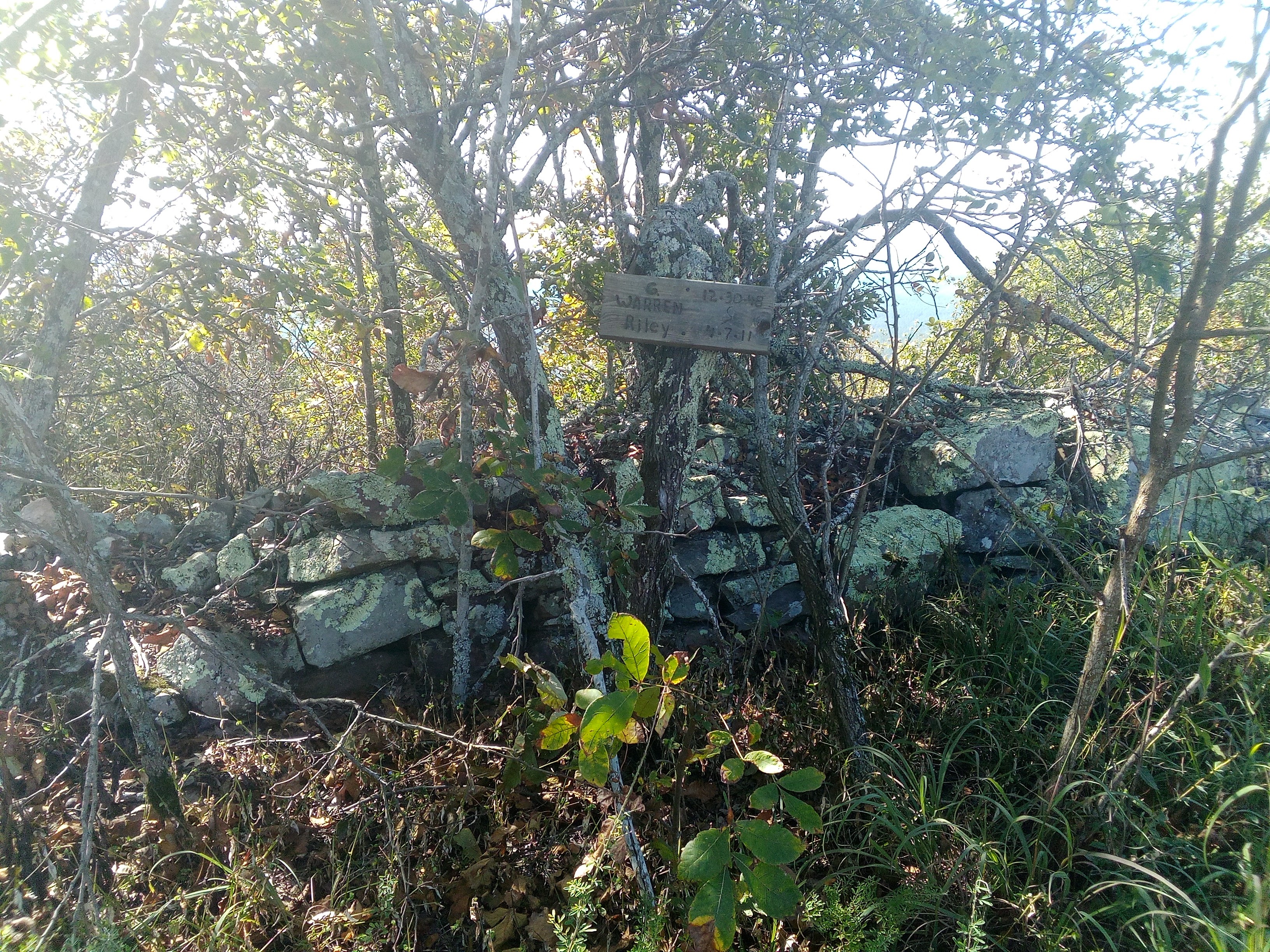
Definitely the most interesting thing about the Ouachita Pinnacle.
  • I saw a tarantula on the trail. I’ve never seen one in the wild before so that was exciting. Even the normal spiders out here seem to be pretty large. It’s pretty common that I’ll be walking along and suddenly realize there’s a spider the size of a quarter is sitting at eye level in the middle of a web it’s spun across the trail.
Their camouflage works pretty well. I had trouble picking this picture out of the gallery to insert in the webpage.
  • On a descending, abandoned forest road, met an West-bound through-hiker named Keenan. He gave me a whale sticker for my water bottle saying it was negative weight for all the joy it’d bring me. He’d had some water scares and was choosing to always keep all of his bottles loaded at every source. I chose to carry an extra liter for a while, but there seemed to be so much water that eventually I decided to stop this. It almost caused a problem at Highway 7 where I was expecting water, and like Eagle Gap, after some walking along a dry streambed, found a small pool almost by accident. There was a frog in it and some minnows, probably trapped as the stream dried up, but after filtering, it was clear and tasty.
This is the Saline River. Mighty enough a body of water to name the county after (Saline County). Listed as a reliable water source which I guess I can’t deny since I did draw water from it.
  • I’d been talking with Lydia by phone before the descent to Highway 7. Service was spotty and I told her I’d call back from the highway. There’s been service everywhere so I didn’t think that there might not be at the road until it was clear that there wasn’t. Given the comms issues I’d had earlier in the trail, I wanted to not leave her wondering what happened, and so charged up hill for the next several miles, finally finding the motivation which had been so lacking in the morning. Sugar creek was a beautiful rocky drainage which the trail winds its way along in that section. In the fading light, the small pools of water in the rock cisterns might have made for one of the prettiest bits of a trail which so rarely uses single-track to explore unique features for the sake of variety. I didn’t linger and wound up hiking the last mile and a half to the Oak Mountain Shelter in the dark after seeing three white tailed deer at a forest road crossing. This wound up being the easiest night hike of the trip. There was cell service at the shelter.

Friday, October 20, 2023

  • I started out from the shelter with a quarter liter of water and was expecting to fill up just two miles into the day when I ran across Bill, westbound, who is hiking a flip-flop. His car is in Story, AR and Lori is shuttling him to each end of the trail at which point he hikes back to the middle. He had pictures of all the water sources until the west end of the trail annotated with their mileage numbers. I never did see Green Thumb spring which is where I was intending to fill up but instead of panicking, I knew I could just keep walking and found a cow pond shortly thereafter.
My boss is also a helpful, detail oriented, Asian fellow named Bill.
  • The North Fork Pinnacle was a half-mile round-trip out of the way. I don’t like non-trail miles but this pinnacle actually had a view.
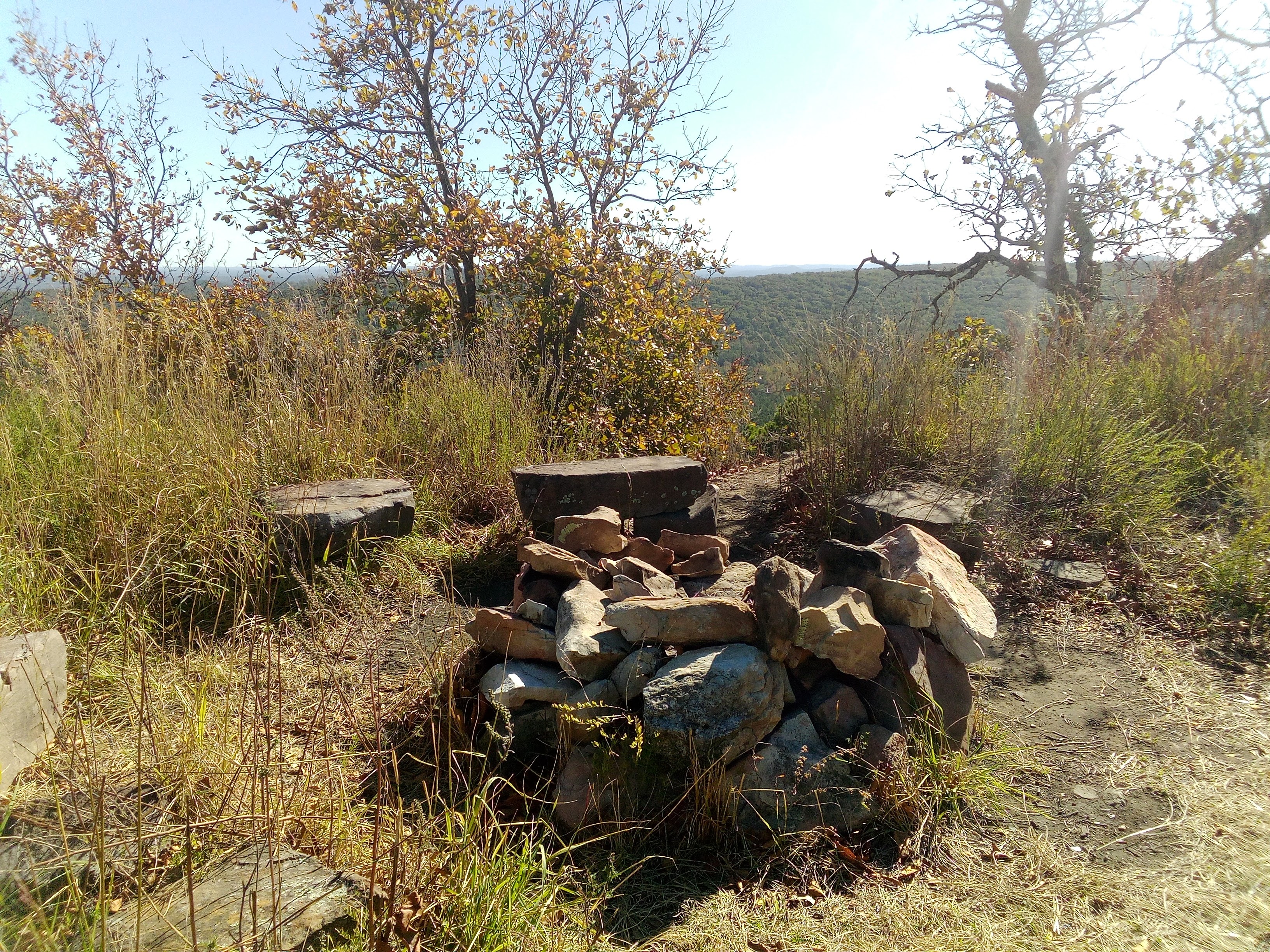
That’s about as good as it gets on the Ouachita.
  • Met Rob and Andy at a the last east-bound shelter. They had genius way of hanging their hammocks from the beams. They’ve been section hiking the Ouachita for about two weekends each year as a way of staying in touch. Inspirational. They’re almost done and I wonder where they’ll go next.
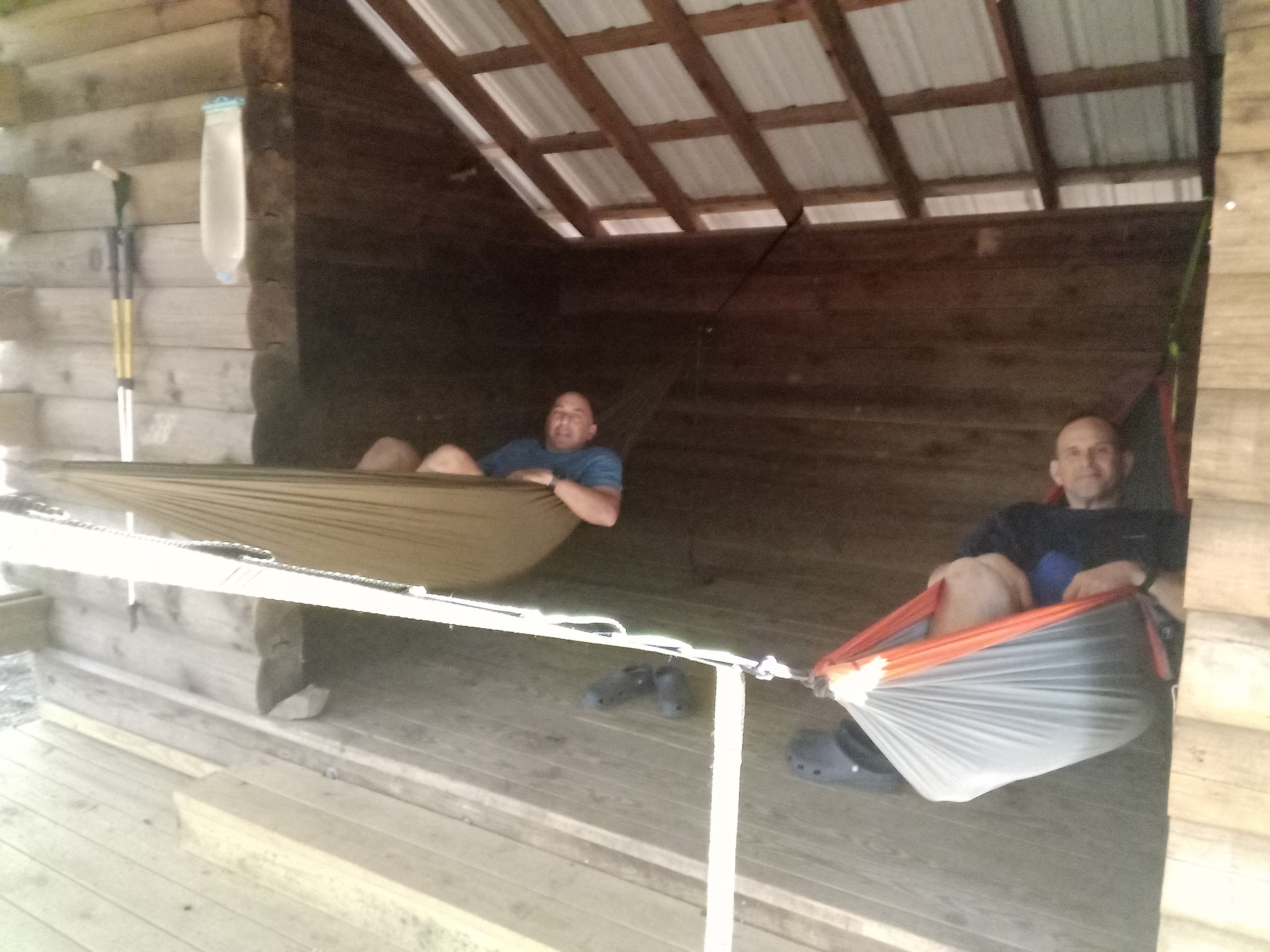
Hammocks seem to be much more popular than tents out here. Every time I passed a camp on the hike, it was occupied by hammocks, never a tent. In my defense, my poncho tarp looks like an upside down hammock on the ground.
  • There’s a section on private property. The trail easement must follow cardinal directions because it tends to move that way, going up and down hills as they happen to be in the way instead of flowing with the terrain. Given that I entered the property in the late afternoon, I was going to be sleeping there and wasn’t sure if that was allowed. I decided I could sleep next to the trail and probably be OK, or at least it was be easy to move on if rousted, but this was the one place where I wish I’d done more research.
This was cool. I’d never seen stones so regularly used as stairs. It’s kinda artistic how no two stone steps touch.
  • On the private property, I took two wrong turns looking for the exit from a gas pipeline cut. Blazes were on rocks in the double-track which followed the pipeline and were a little sparse. The road turned right after crossing a stream bed (my first guess) but cut also continued straight (my second guess). It wasn’t until I turned around and hiked back a ways to find the last blaze I’d seen that I saw an obvious turn-off with trees on each side of the trail blazed. The blazes were just facing such they couldn’t be seen in the direction I’d originally been hiking but were hard to miss when coming from the wrong direction. Dusk had been falling so I’d gotten in a little panic. The trail corridor thereafter was quite reassuring. There were even 3 colors of blazes: blue, yellow, and purple.
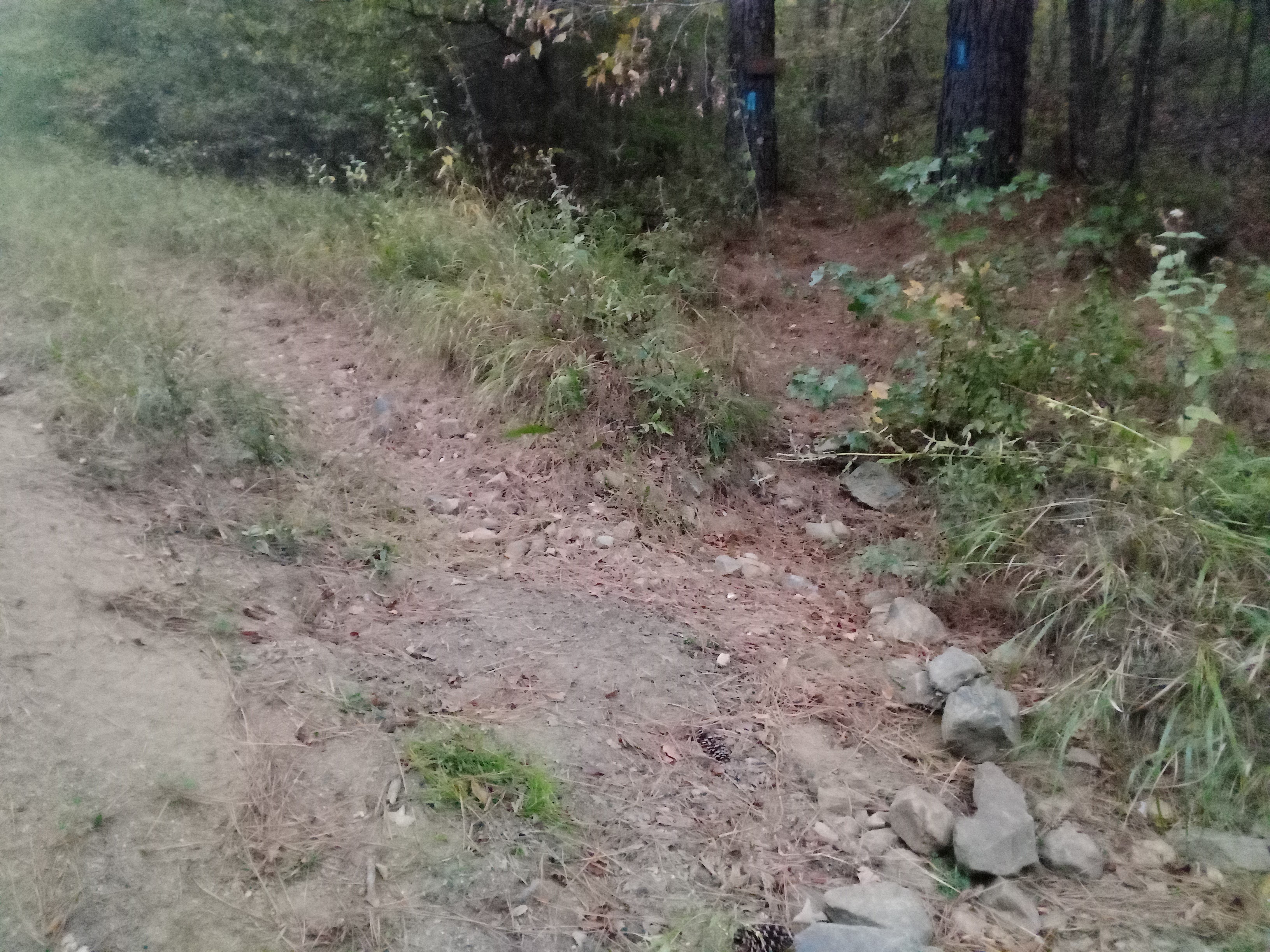
See how easy those blazes are to spot? That’s because I’m hiking backwards down the double-track. I moved the rocks in the bottom-right into position so hopefully there’ll be a little more indication that this is the turn-off.
  • Camped just before the Maumelle river near the last blue blaze I could find. Flooded areas near rivers can make the trail hard to follow because the trail bed gets washed out and brush gets rearranged. Despite returning to the last known blaze and setting out along several directions, it wasn’t until light the next morning that I could see the way – at which point it was almost obvious.

Saturday, October 21, 2023

  • I waited for light despite wanting to finish early today. An early finish would make it easier to find a hotel room with a shower and laundry facilities. Not finishing today would mean trying to clean off in the Maumelle Reservoir before spending a day on airplanes. The advantage of light is that I didn’t spend time lost where the trail was faint in the river valley. Fortunately, this was one of the more heavily blazed sections.
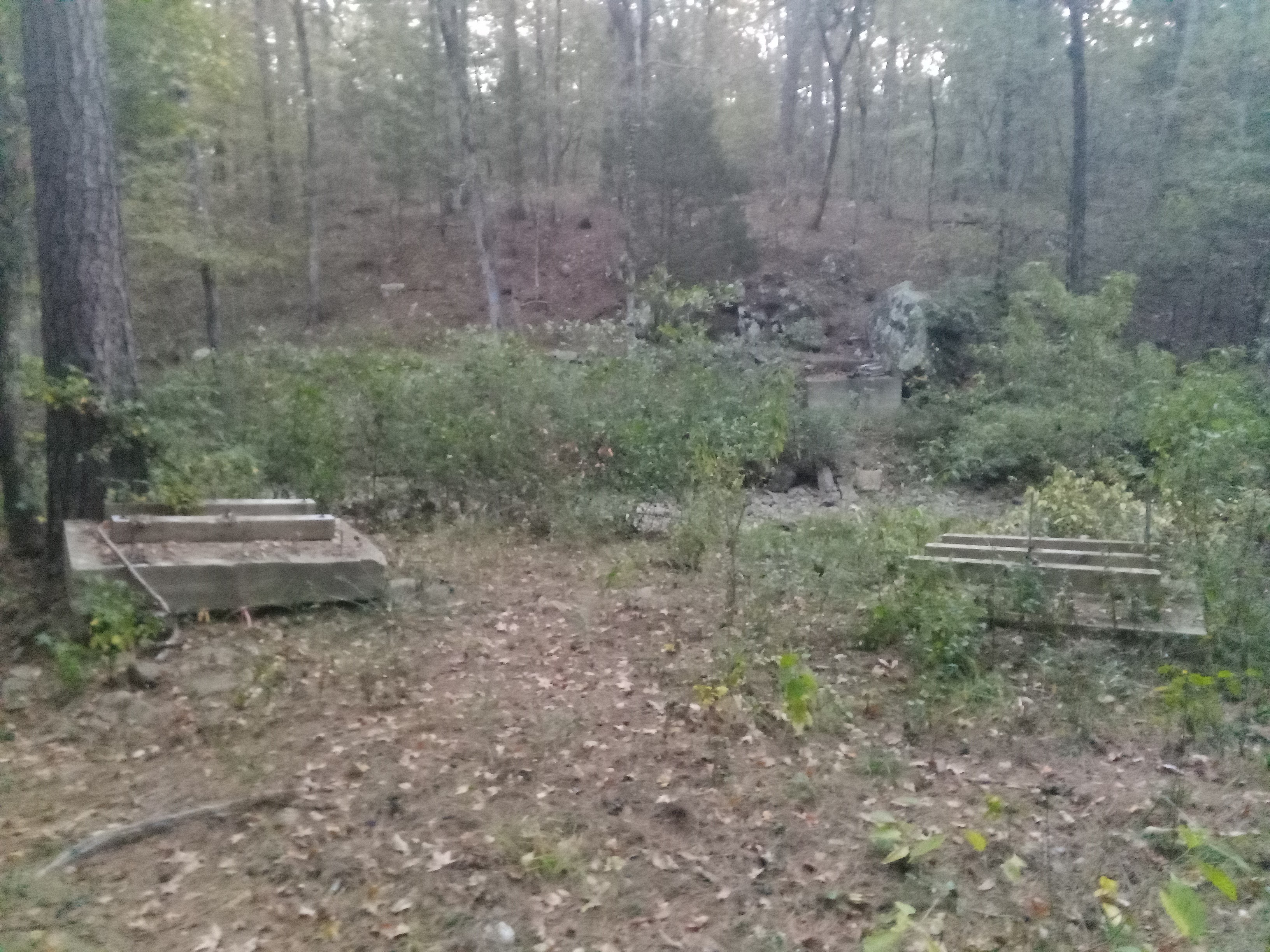
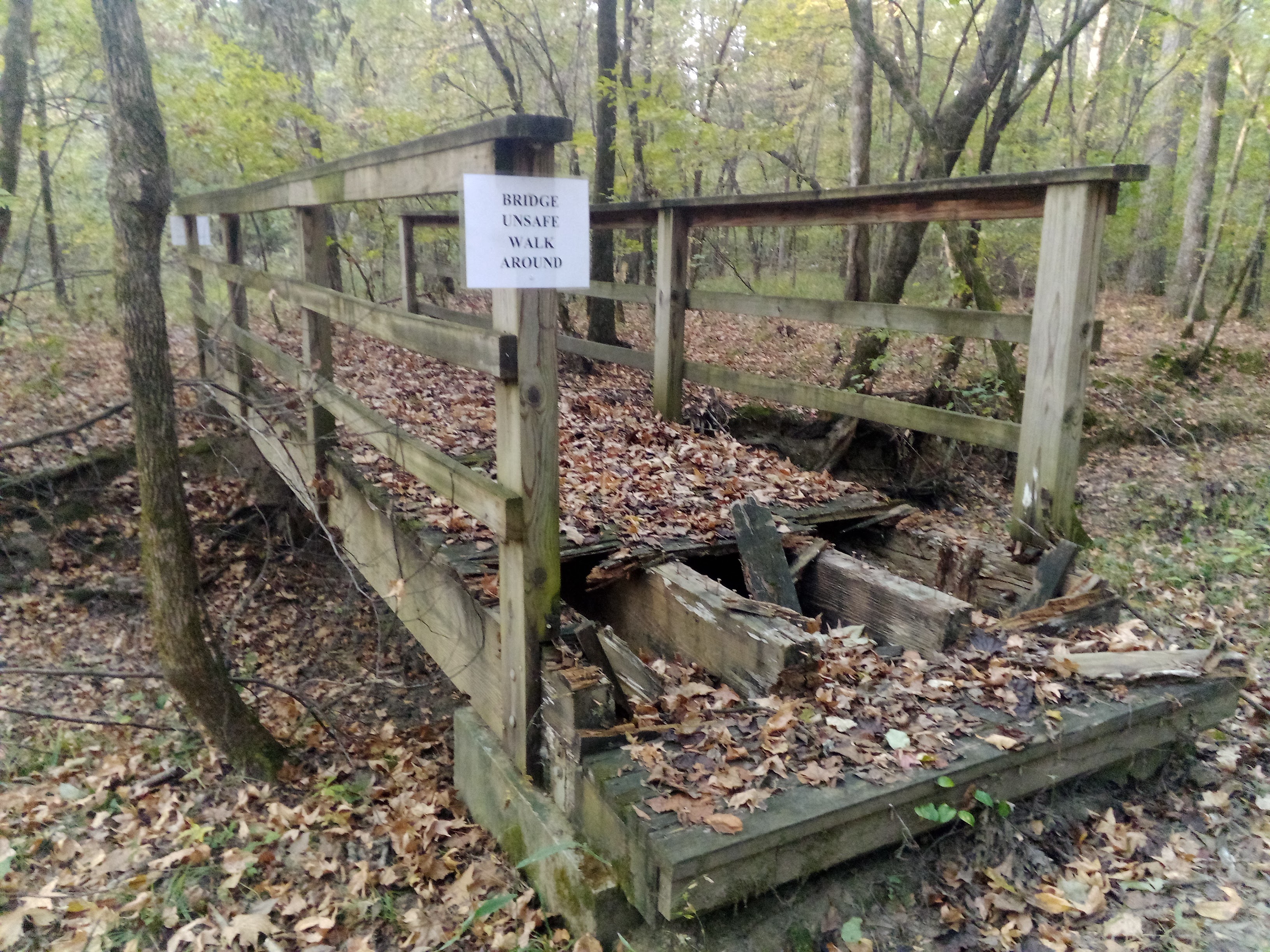
Good thing this bridge wasn’t important.
  • For a mile or so, I walked within sight of the Maumelle river. Birds were signing. Some ducks were flying along with their feet in the water, not quite taking off. It was idyllic except that there was a lot of road noise from a highway just out of sight on the far bank. At this point I wished for a canoe that I could put in and paddle down to the reservoir which ends a few miles short of the trail’s eastern terminus.
It’s hard to get a clear shot with the trees (true of very picture on the entire trail), but walking along the Maumelle River was very pleasant.
But doesn’t the presence of a bridge imply it would also be unsafe to walk around?
  • Had trouble crossing a power line cut. The trail seemed to disappear when entering the cut, but actually went right for ~10ft then entered the dense brush. There wasn’t an obvious exit or blaze on the far side. I followed a game trail across and got scratched up, then searched for a blaze, finding one in a few minutes. I walked the trail back under the power lines to see what I’d missed, it was very easy to follow – I’d just need to take a few steps to the right. It’s incredible how such small misses can have such large impacts.
  • Met an older couple who lived in the area. They told me an aggressive dog had been reported near Lunchford’s corner. I wasn’t sure where that was, but I was glad to hear that the sign saying Pinnacle Mt State Park was 12 miles away was actually about 10 miles. They’d measured it.
  • Crossed the dam which creates Maumelle Reservior. No shoulder but fortunately light traffic.
From the Maumelle Dam looking west. One of the most expansive views of the entire trail.
  • The western part of the trail over the north side of Maumelle Reservoir crosses many (dry) streams and would be very difficult to follow if it weren’t heavily blazed. The trail feels like it wanders enough as to be a little disorienting. There’ a slight slope towards the lake and sometimes you can see lake water sparkling in the distance through the trees. It felt a little chaotic and I wonder how the route was initially chosen. Why not just walk the shore of the reservoir and enjoy the view?
  • The eastern section of trail which passes over north of Maumelle Reservoir rolls, has few views and the blazes are fresh. I was getting very attached to counting down the miles at this point.
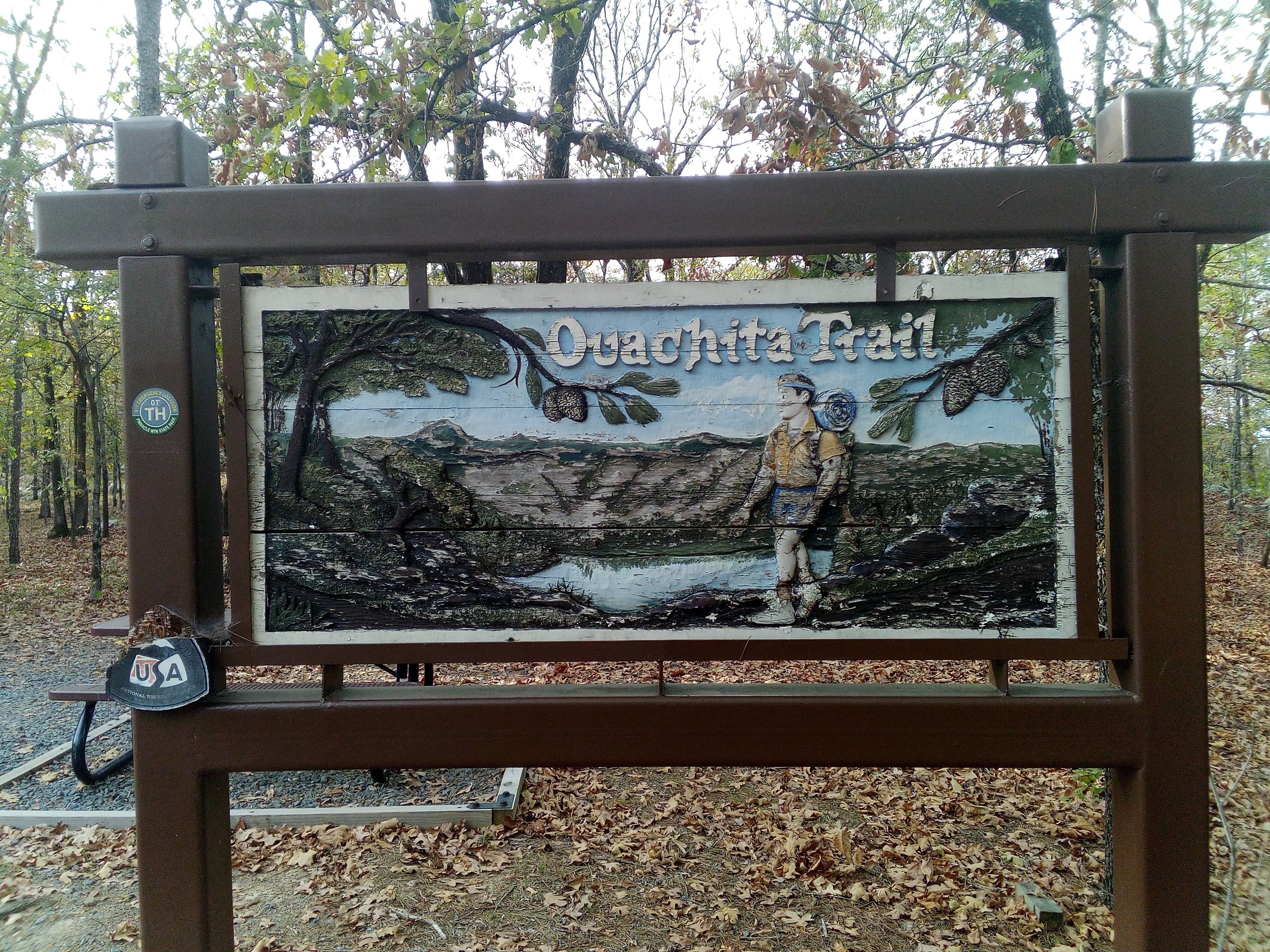
  • The end of the trail is actually a little complicated. There’s a road walk. You enter Pinnacle Mountain State Park through a corner of woods at a traffic intersection then walk past the base of Pinnacle Mountain before exiting through an archway which I thought was the terminus of the trail before seeing another blue blaze across the parking lot. The trail continues to the other side of the park on what feels like a decommissioned railroad bed. After the steepest climb of the entire trail, you come out at the lower parking lot of the visitor center where there’s a large mural titled Ouchita Trail. Nothing actually states that this is the eastern terminus, so I wandered up to the visitor center proper just to be sure I’d finished.
Turn out this is not the finish…
The end?

Mint – Snowbird Traverse (August 5-6, 2023)

This is a trip about which I wax philosophical. I’m sorry. It moved me.

Saturday, August 5

This adventure started with a U-turn. On my way to the trailhead, I was struck with a terrible sense that I’d left the garage door open. I’d also forgotten my ice axe and head net but who needs safety or comfort? Not getting killed by my girlfriend (now wife), who was out of town for the week, because the fish had been stolen out of our chest freezer was the deciding point. I was even able to water the garden so it wouldn’t dry out while we were away.

I typically have very little patience for eating when there’s hiking to do. The best breakfast is one you can eat on your feet. Tomorrow, I would pick my way down a social trail with an expensive, bright yellow package of bland, rehydrated trail breakfast in one hand, a spoon in the other because I lacked the patience to stop for longer than was required to boil water. Only Andrew Skurka seems to be able to make oatmeal delicious in the back country, and as I understand it, he had to pay a professional chef to figure out how. All this is to say that, despite my natural tendencies, I ate lunch at the trailhead instead of on my feet while they carried me down the valley. Not having to carry the empty packaging preserved the feeling of a clean start.

The path out of the Gold Mint trailhead is flat, wide, packed, and grainy as though made from a yellow sand while not being soft like a dry oceanside beach. The most common animal at this point was the domestic canine, though several wild cyclists passed me heading in the opposite direction. People sometimes ask about danger from animals in the back country. I’ve never encountered an unreasonable bear. I have encountered unreasonable humans. I saw several humans openly carrying guns and wondered what I should do. Bear protocol seemed to work: make sound so you don’t surprise them.

The river in the middle of the glacial valley would visit briefly with the trail at silty openings in the brush where children, dogs, and one smoker enjoyed the water. I think the trail builders forgot about the mile 2 marker, otherwise I was walking at 10min/mi after 3 miles. Eventually, the trail turned boggy, then bushy, then bouldery and back again to bushy and boggy. It became more of a “social” trail with elements of bushwhacking than a “trail” trail. Apparently my bear protocol wasn’t so good. I surprised a pair of heavily laden backpackers wallowing their way along, doing combat with small branches.

This hike would make we wonder about the qualifiers we give to trails. When is a “trail” a “route”? When is a “social trail” more of a “game trail”? If there’s a boulder field and it’s obvious where to go but there’s no canonical way to get there, is it still a trail? If you happen to get the same place everyone else did by following broken vegetation, scuffed lichen, and sometimes your own nose, is that a trail, a route, a way, a ‘shwack, or just an adventure?

Those questions wouldn’t be raised until after the Gold Mint Hut, towards which, the Gold Mint trail now began to climb. I passed a red faced, sweaty fellow in a cowboy hat and holster, belly sagging over his belt as he sat on grass with his legs over a mud puddle. Children played around him in a small clearing. It was hard not to judge him as in over his head. A short while later, I stopped to get beta from a lean, tan climber who’d casually stepped aside to let me pass. He’d been out for a few days, summited a nearby peak in the morning and was heading out for a town day. He’d referred to the peak by name, assuming my familiarity with the area. I thought Montana was a state. My nervous, repeated questions about snow and trail conditions contrasted with his easy manner and must have left him with the same thoughts I’d just had about the seated man. Apparently the high snow year had left a hard snowpack and it was good that I was going over Backdoor Gap later in the day so the snowfield would be softer. It wouldn’t be a problem if I was good on my feet, he said. The way to Snowbird Hut was like this, he’d said waving his hand broadly at the steep, brushy, mountainside but without a trail. “Like this but no trail” I said. I’d just been appreciating how the social trail left just enough weakness in the bushes for my small pack to sneak through.

Glaciers, hidden at the back of hanging valleys began to appear. The view expanded to have a below and not just an above. The sun was bright. The sky was blue. The ridges were ragged, the valley bottom green. The trail was a fall line picked carefully to avoid ravines and sheer rock faces. A stout young man, stepping confidently on the steep tundra-covered rocks commented on the quality of the day. In a brief exchange, he mentioned making a living off social media. The drone in his pack was for work. He hadn’t gone over the pass and I wondered if it was because he had to get the footage edited and published to maintain engagement with his audience. Why not do a longer trip, perhaps the entire traverse instead of just going to the first pass? The view was good, but the experience of hiking up to a beautiful view is never as rich as walking through a beautiful view. He asked me if I was out for a day hike. Something about the small pack.

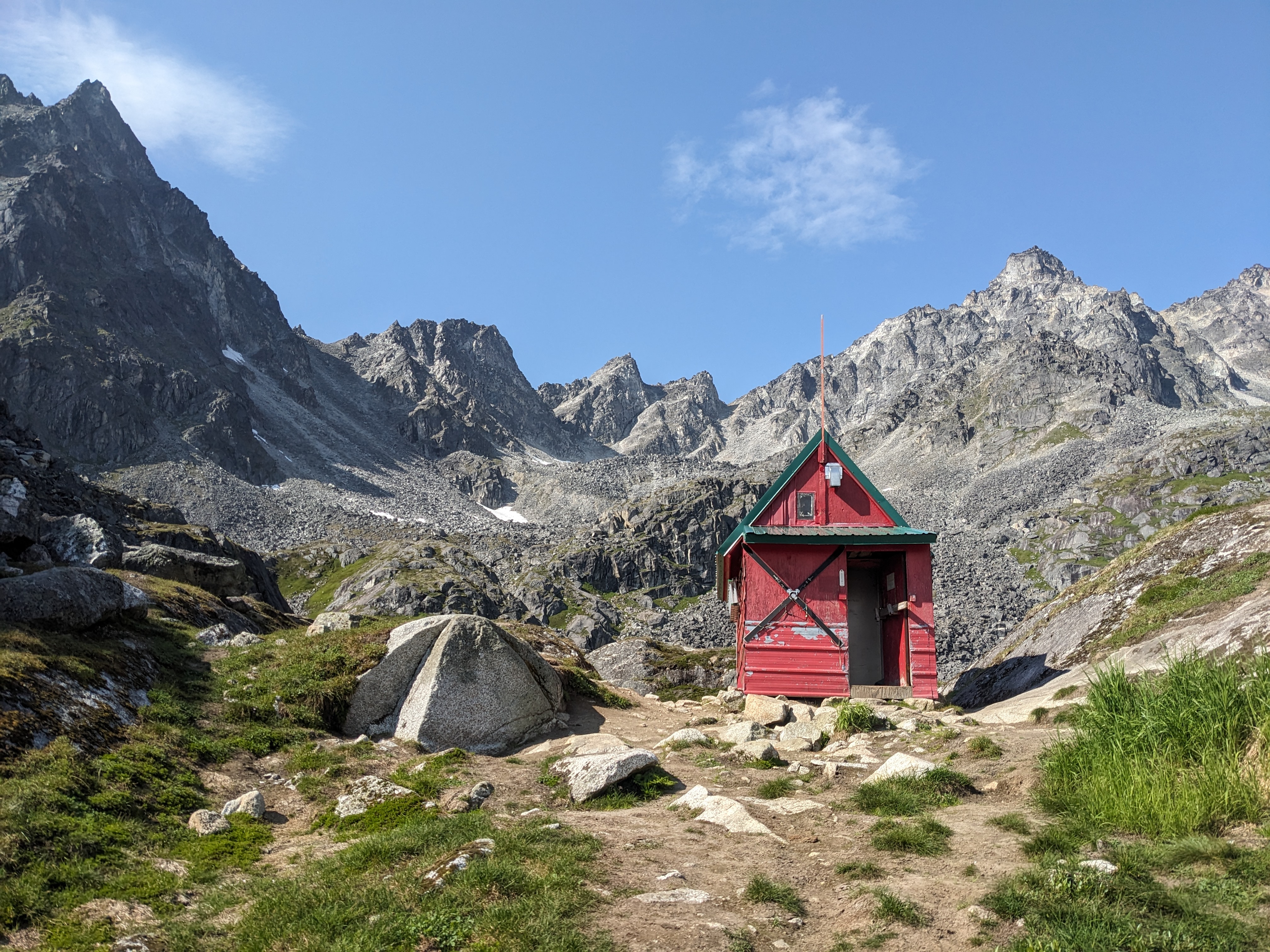
The Gold Mint Hut is red. Classic barn red and just as faded. The contrast with everything surrounding it fits perfectly with the feeling of arrival when my slow, upward pace made it suddenly rise out of the bowl on whose lip it rests.

There was a pair of hikers enjoying the view. In contrast with the loquacious, if brief, encounters with other hikers, these were kind enough to direct me to water before moving regain some semblance of solitude. It was a nice reminder that good etiquette out here is centered on giving everyone as much of the wilderness to themselves, not connecting with others through shared enjoyment of the outdoors, even if I’m prone to do the latter.

From the small stream behind hut, the trail washes out somewhat. Simply identify the correct pass, and walk up the gravel. There is a social trail on the south side which looked to me to be more difficult than hopping from stone to stone because at such a steep angle, any dirt under the foot would want to become dry lubricant. A fellow was descending that way carrying two packs. His companion was unburdened but moving slower and I intended to inquire if all was well. He beat me to it with a cheery salutation.

Just short of the pass a helicopter flew overhead. The sound came suddenly, perhaps blocked by the ridge until it was overhead. Low flying helicopters appeared several times while I was at Backdoor Gap. I assumed that some were for search and rescue but others had a more military look and I wondered if the used the area for practice.

I stopped frequently on the climb as I haven’t kept up with the sorts of efforts which occupied me for the last several years. The view was progressively more engaging so photography was my cover story. At each stop the view inspired awe and so I have a collection of images which were all breathtaking in the moment (though my breath may have also been taken on account of exertion), but capture views lesser than the one from Backdoor Gap itself. I usually try to skip taking a photograph if I know I’m about to get a better view but just couldn’t help myself.

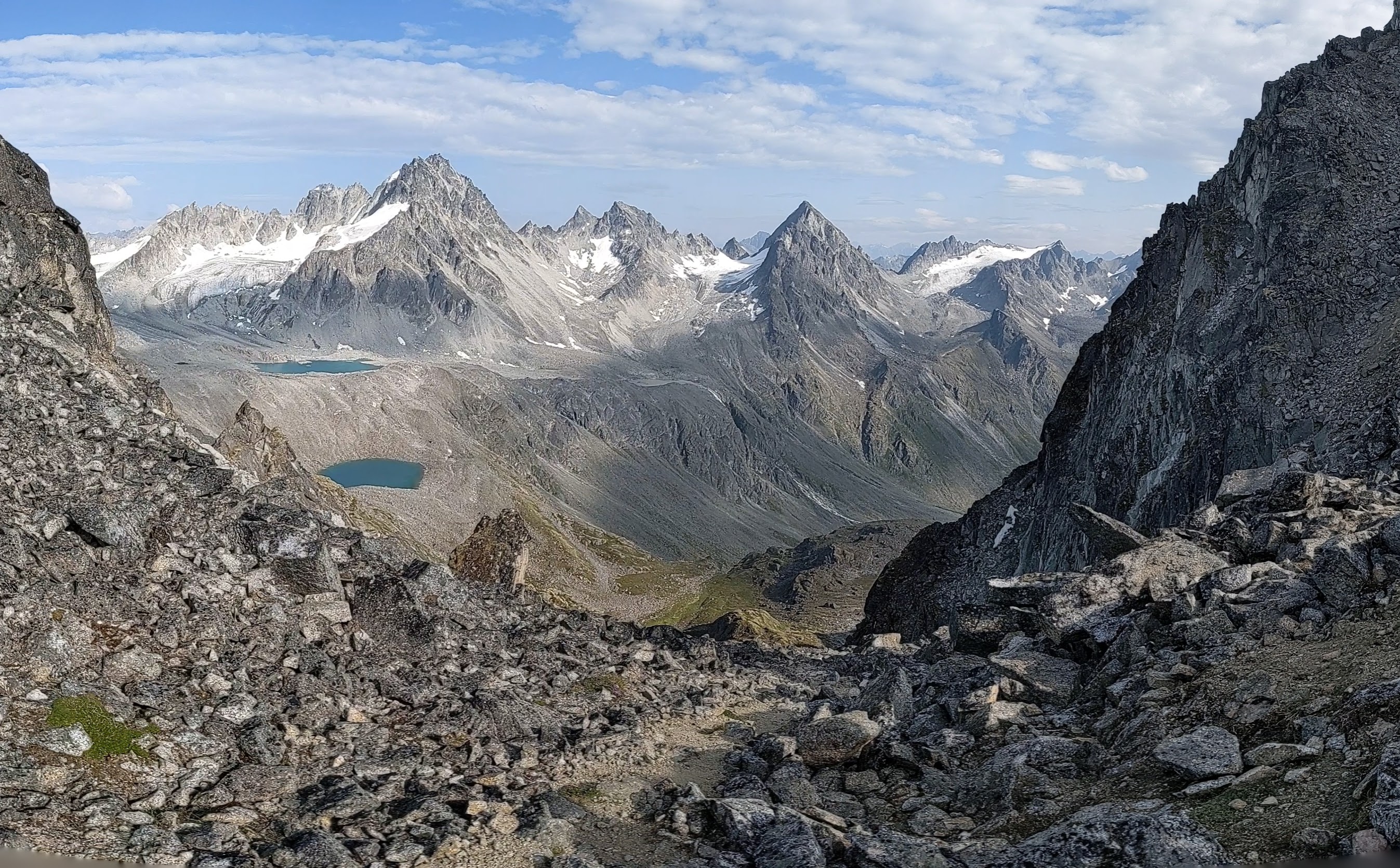
Looking back (East) from Backdoor Gap. I have lots of pictures of the same view on the way up. Should have just waited for this one.

The view to west of the gap was no less exciting. I felt as though in several hours I’d gone from home to the best of what I’ve experienced in the Sierra Nevada. Passing to the interior side of Backdoor Gap, I suddenly felt a significant distance from people even though several I’d met had come this way earlier in the day.

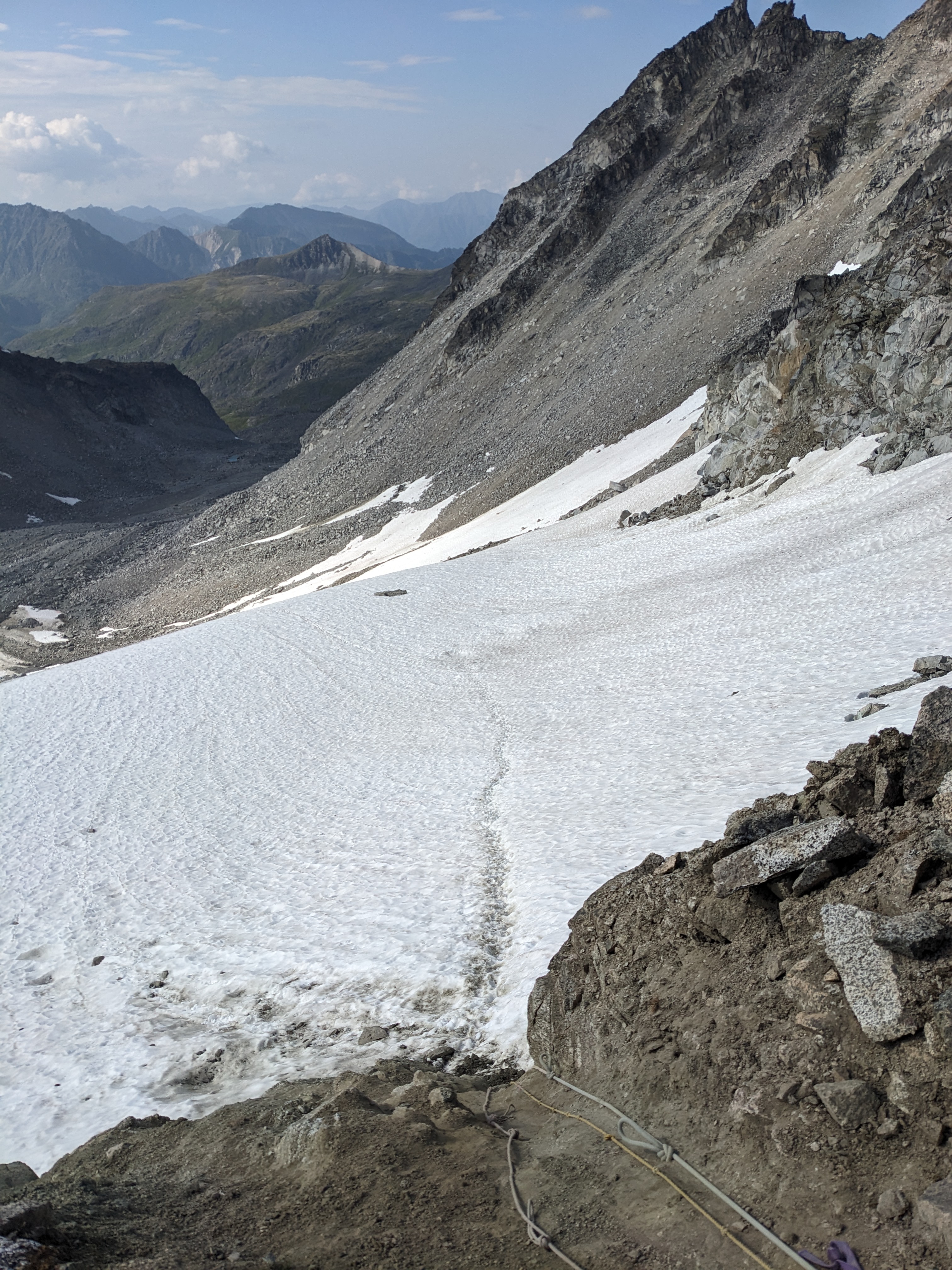
View to the west from Backdoor Gap. Nice of someone to leave a rope.

The mid-afternoon started by descending a rope about 15 feet to the snowfield. I had the bowl to myself and reveled in it. My route would trace the path of water, starting at the top of a snowfield, descending to where the snow was melted and ice remained, descending to where the ice melted into desolate field of rock and silt, descending still to where trickles coalesced into streams and the pioneers of the plant world began to put down roots. The plants formed a gradient in their density and size, reaching a full ground cover where the lip of the hanging valley diverted the gathering stream to one side, denying it the most direct route to the valley floor.

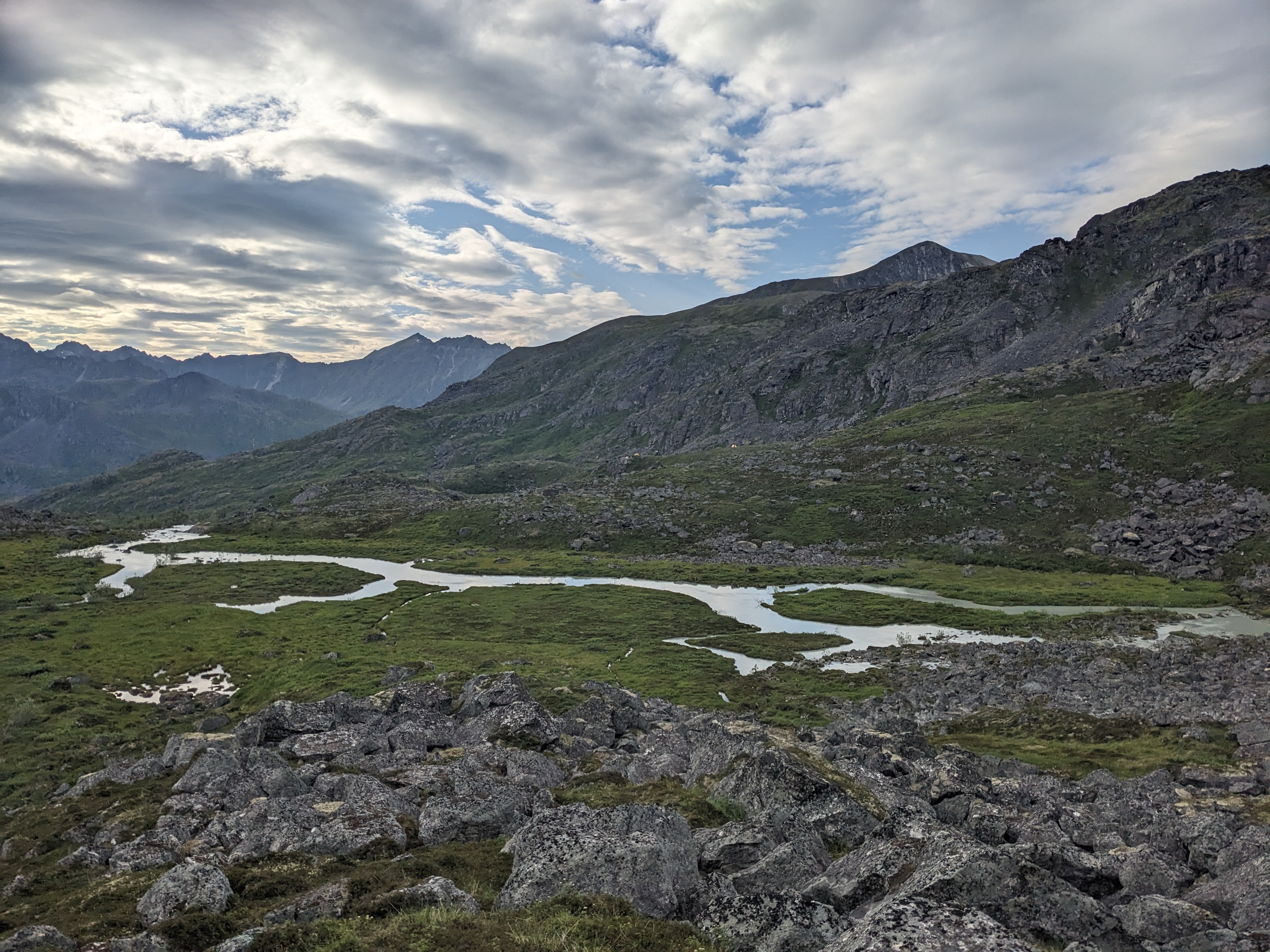
Between the desolation just below the ice field and the fully vegetated lower valley with a single distinct river.

In passing this way, I deigned to wear traction devices until I found myself on the glacial ice where the snow had melted away. It felt like a rare honor to witness this process of glacial retraction. Glaciers had once covered all of these valleys. It seems that soon plants will replace them. There is a seasonal process as I’m sure the snow is somewhat deeper in the winter and some of the frontier plants freeze to death but over years the line of vegetation has chased the ice up the valley, reached the lip of this hanging valley, and is continuing its pursuit. I felt blessed to be witnessing the beautiful mixing of the two on this trip and felt sad at what my surroundings made so obvious – that the green from below will rise like a tide until all the ice disappears under it.

Elegiac feelings aside, I now had to find my way to the Bomber Hut. No trail had emerged, but the map had indicated it was on the north side of the river, somewhere after the river formed. Precision didn’t matter, accuracy did. So I found my way across rocks here and low bushes there. Springing over a brook and tip toeing along a hill side of large rocks. This is the freedom of off-trail travel in good terrain. Such is the pain of off-trail travel in poor terrain. That would be tomorrows problem. Today, I only felt the freedom.

That looks like a river. The hut must be somewhere on the other side. Who cares where? Who cares to how to get there?

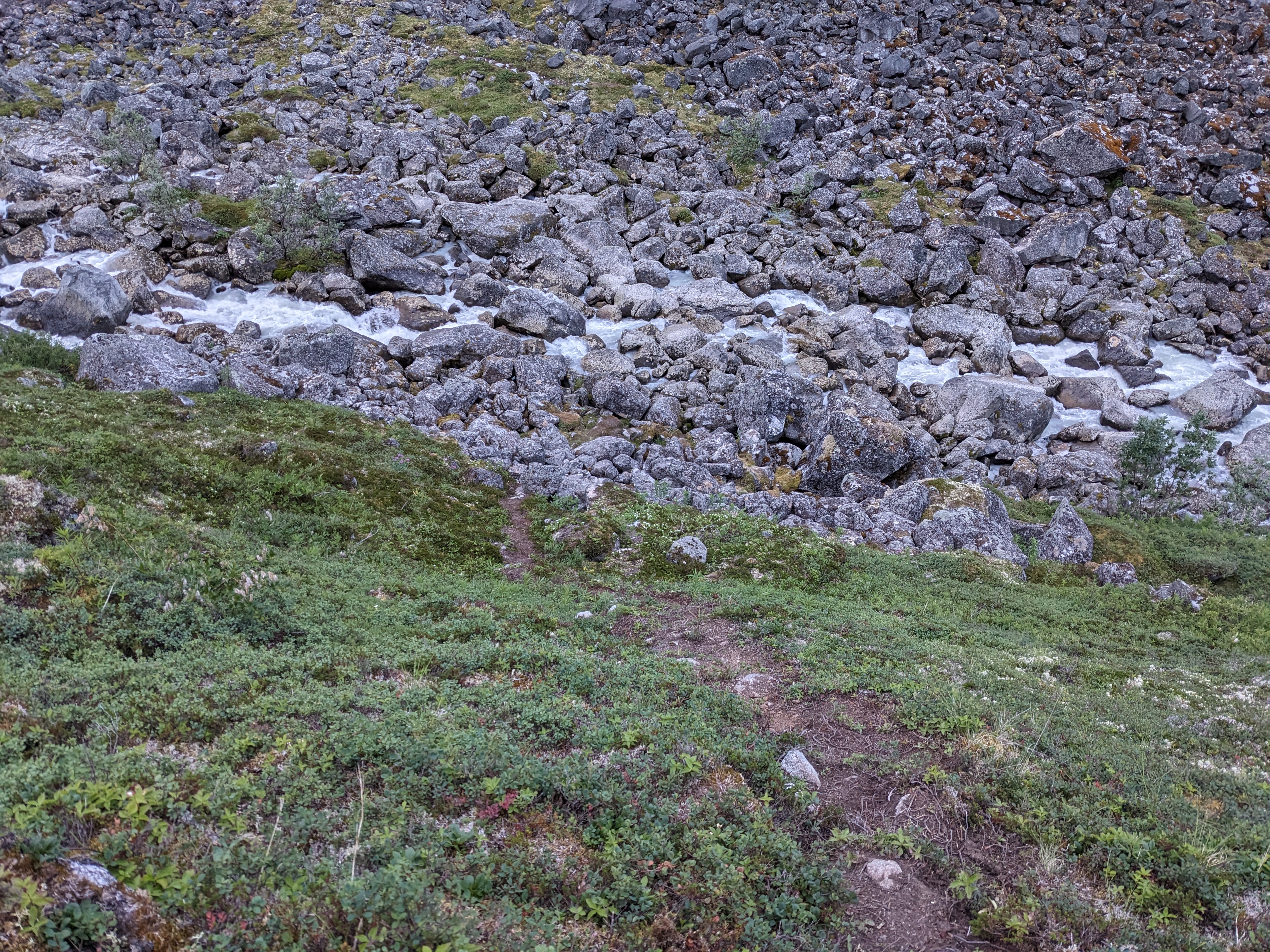
Wanting to keep my feet as dry as possible, I found my way around the head of the river. It came down from another hanging valley under a tumble of large, weathered, lichenous rocks. I could hear the river beneath the rocks while I hop-scotched my way across, thankful that a light pack made fancy footwork fun. Clouds were beginning to gather and rain had been forecast, though not much. Not much might mean anything, of course. I wanted to find the hut so as to be secure in my position (precision, not accuracy). This is an odd thing as I could align every valley in view with the map and so there was no question of getting lost in the big picture. Yet, when I wandered in to the warm, green building crowded around with tents and crowded inside with people, I felt a security which provided a satisfying counter-balance to the brief absence of human company that afternoon.

The company in the Bomber hut was welcoming and conversation pleasant. I learned that there an excellent map set of the area is freely available so that I needn’t have drawn my own line or been so deprived of information about conditions. This area is well traveled yet retains an intoxicating, primitive feel. I took a picture of someone’s GPS with routes down the valley. I planned to exit quickly over Bomber Pass if the rain came early tomorrow, but attempt to find my way to Snowbird if I thought I could get a dry start. A woman who had come that way said it had taken the better part of a very foggy day despite having a GPS to come this way from Snowbird. I bid them goodnight and camped a short distance down the trail leading west from the hut.

Nice to know where I’m going.

Sunday, August 6

I woke, broke camp quickly, boiled water for oatmeal, then soaked and ate it while walking down the trail which descends from the Bomber hut to Wintergreen Creek. I hadn’t known about this trail and it greatly expedited my morning while also answering the key question of where to make the first of the two water crossings I was expecting today. The oatmeal was expensive and bland but the packaging was bright yellow on an otherwise overcast day.

And so ended the easy part.

The social trail seemed to come and go on the far side of Wintergreen Creek. I quickly lost it in a rock slide where I thought I saw evidence of footprints above me, only to see a brown scratch in the green foliage next to the river. The brush was now dense enough that missteps had consequences. I had a constant fear of floundering through alders for hours because I couldn’t see the proper path just a few feet away. My guiding principle was now to follow the path of least resistance. This principle hinges on the fact (or hope?) that no animal wants to flounder through alders and so bears, moose, humans, goats, etc… will all be funneled to the weakest point in the bushes. By individually rejecting the less pleasant options, they collectively maintain a passable route through what would otherwise be overwhelming plantlife. My second principle for the day was not be an idiot. This is a somewhat more subtle principle as it relies on common sense and common sense takes a good deal of practice to develop at an intuitive level. Until that is achieved, I, in particular, am prone to overthinking.

Knowing that I wanted to follow the river to the next valley then turn up that valley before crossing the river, I went whichever way was easiest as long as it kept me near the sight or sound of water. This path of least resistance soon began to conflict with the principle of not being an idiot. I found myself about to descend about 10 or 20 feet into deeper brush which appeared to start to form a cut which would carry the stream down the valley and past my turn. My goal was to diverge from Wintergreen Creek, travel up Barthof Creek, and so, while I wasn’t sure quite where to go, it seemed important to turn around and begin my turn up the valley forming on my left. This was a lot of thought for what might have been summarized as, “turn left at the next valley”.

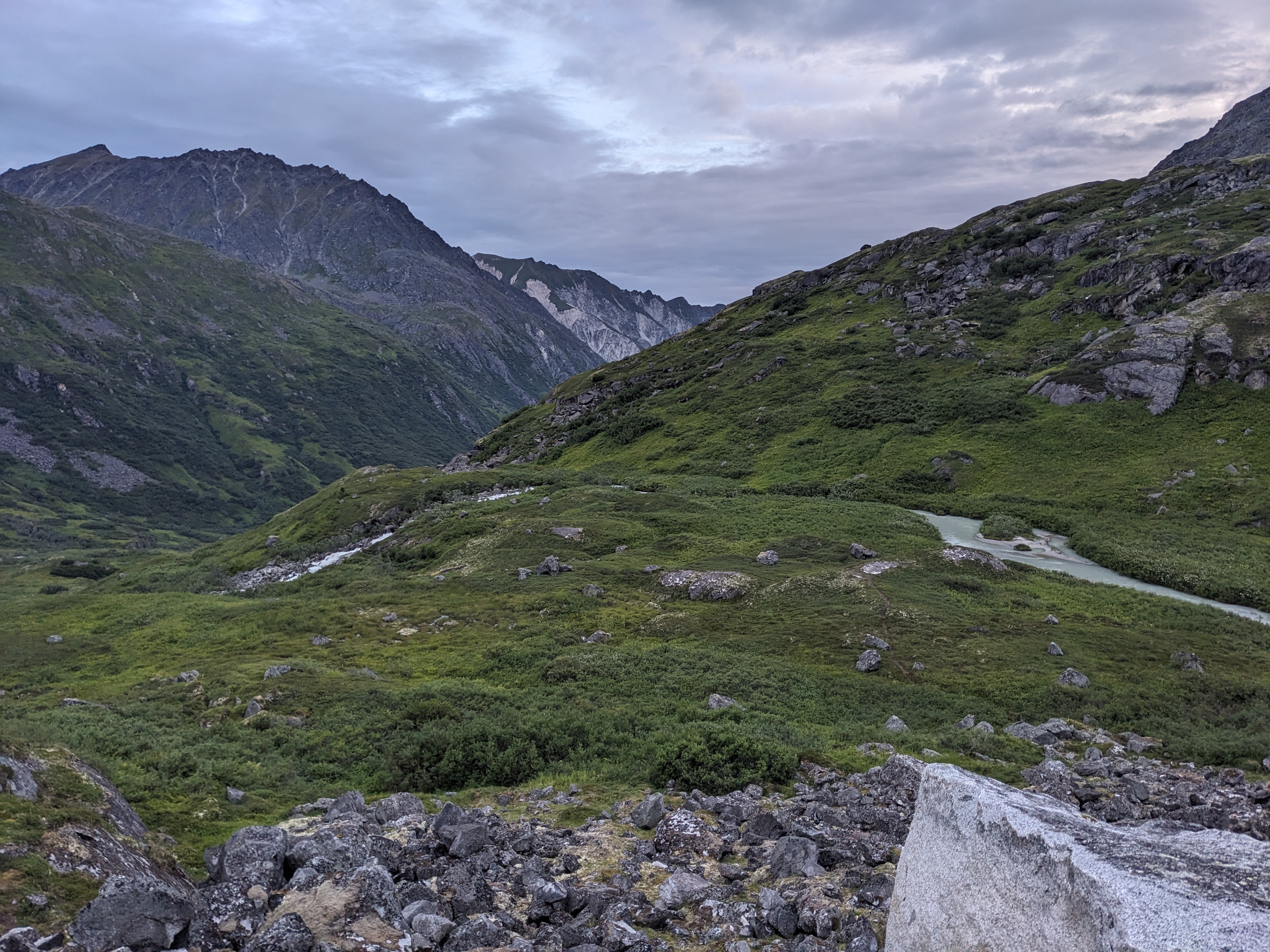
Overlooking the riverbend where “path of least resistance” would meet “don’t be an idiot”.

And so I wandered with a loose aim, making slow progress and finding hints of others’ passage like this:

I was unbelievably excited each time I happened across a few feet of “trail”.

Short sections of trail would sometimes emerge. It seems that where the plants are slow to grow, the path holds well, but there isn’t enough foot traffic to keep the more aggressive plants at bay. I felt I was rediscovering some lost civilization, not simply walk a popular hiking route.

The next big movement was to cross Barthof Creek somewhere before Snowbird Lake, but I wasn’t sure where. When looking at topo maps before the trip, the terrain hadn’t struck me as particularly difficult and so I figured, I’d cross wherever it made sense. When looking at those maps, I’d interpolated a smooth gradient between the topographic lines and imagined them covered in low, tundra-like vegation. Reality was somewhat more like a series of step functions with bushes which could defend themselves. I walked the line between least resistance and idiocy a few times. For example, even if its easy to get to the waters edge, there needs to be an exit on the far side to complete a crossing. If there’s a weakness in the wall of bushes on the far side, you can’t cross in the middle of a water fall, though that idea would be tested later.

At one point, I couldn’t decide whether to cross or not, and broke the tie by looking the picture I’d taken of the route the night before. While I wasn’t particularly sure where along the valley I was, the crossing was slight above 3200ft. My elevation was 2800ft. I wasn’t there yet. I had learned about using an altimeter to locate oneself on a map during a wilderness navigation course several years ago but this was my first time using the technique.

A particularly exciting place for trail to appear as it would lead me to the second water crossing of the day.

The path of least resistance eventually resolved into a trail which lead to a well tread ford. It continued on the other side and was steep in places. I wound up scrambling boulders up a rocky ravine only to spot a social trail on the far side of the knoll at the top. It had looked so much simpler on a map, but maps don’t show the drop offs, large boulders, and small gulleys which don’t go where you think they would. Perhaps a more experienced backcountry traveler would be able to keep the big picture in mind and see through the obstacles, but I felt very much alive finding my way in places. At one point, I could find no way up other than a hand-over-hand scramble for a short distance with a hundred foot fall into Snowbird Lake if I had slipped. Yet, there was scuffed groundcover to follow and other rock faces seemed even more intimidating.

I was still below Snowbird Lake when the forecast rain started. I had thought that reaching Snowbird Lake would put me within easy travel of Snowbird Glacier but this proved not to be the case. Since I was stopping anyways to put on rain layers, I took a picture. Since I had my phone out anyways for pictures, I looked at the map stored there and discovered that the Snowbird Hut was on the south side of Snowbird Glacier. My current intention was to ascend the ridge to the north. Oops. I was well positioned to get back on course by crossing a stream descending from the glacier’s outlet lake. This looked like a simple task until I got close enough to realize that all of the shallower places lead to frothing pools where the turbulent water would press hard to sweep me away while I was feeling around to place my foot among rocks hidden at unknown depth by the torrent. In some places, I might have risked a long jump but the possibility of beings carried over a ledge if I were to fumble the landing on a smooth rock made slippery by rain kept me from making the leap. After several exploratory attempts to cross, I pulled out the hiking poles which had remained stashed in my pack the entire trip, sometimes catching on branches in taller bushes. These helped buttress the few steps it took to cross a deep, raging pool to a shallow, rushing pool and continue up the ridge of boulders that fell away steeply to Snowbird Lake.

Snowbird Hut was marked on my GPS but I was enjoying the game of using the GPS as rarely and as minimally as possible. At first I continued following the outlet stream, staying on the boulders a little above. I passed tents which so far on the trip indicated that a hut was nearby. Someone the night before had told me Snowbird Hut was hidden until one was almost upon it, but I found more time passing and the ridge varying more than I expected. Eventually, I succumbed to the desire for certainty as to my position and the fear that I’d missed the hut and looked at the GPS. It was still ahead. The ridge was simply more difficult than I’d expected.

Snowbird hut finally shows itself. My patience with the rock field was growing thin at this point.

I ate lunch on the porch of Snowbird Hut but for some reason never thought to go inside. The company on the porch was good – a pair of wilderness therapists spending their vacation in the wilderness. I idealize work in the outdoors industry as vacation trips like this feed my soul. While the pair clearly found joy and meaning in their work, it didn’t take much reading between the lines to see why they weren’t expecting long careers in the field.

Moving on from Snowbird Hut, I naively assumed that I could continue walking the ridge. Apparently I hadn’t yet learned my lesson that boulder hopping in the rain just grinds me down rather much more than walking a sunny, maintained trail. After a hundred yards or so, I realized that I could make my way around some drop-offs to Snowbird Glacier and walk up its smooth, perfectly graded surface with traction devices making for effortless footing. This freed my mind from the details of micronavigation to experience the awe such surroundings naturally bring to someone who experiences them infrequently. I walked up to Snowbird pass fascinated by the way streams of glacial melt form small and large crevices, some deep and sinuous. It was quite literally like getting to see a giant ice cube melt.

Across Snowbird Pass, the landscape remained inspiringly rugged, but changed from a grey ice-scape to an increasingly luscious mountain valley. A trail was easy to follow and only disappeared twice, the first time near a delightfully long boot-ski opportunity and the second near some old mining equipment.

The descent was steep enough that where red dirt was exposed, it was convenient to have an old cable, perhaps from a mining tram, available as a hand-hold. In other places, the cables crossed the trail about ankle level and were the perfect tripping hazard. The miners employing them presumably had a gritty, hard won life on such steep slopes. A pleasure trip isn’t fair comparison to daily life, but I felt a greater connection to the miners by encountering their abandoned, rusting infrastructure in such a physically demanding experience than if I had encountered it a polite museum exhibit. At the base of the descent, the trail merges with the valley’s main thoroughfare to Reed Lakes. The path whence I came is unnamed on the signpost at the fork. If you don’t know, I guess you shouldn’t go?

The way from which I came apparently doesn’t deserve a name.

The trail was now flat, wide, packed dirt and ran along a stream. This felt like the home stretch in that it carried me as fast as I could walk past day hikers and was a return to the conditions from which I’d departed a little less than 24 hours before. At the trailhead, there was a map with a large “You Are Here” highlighted. It was perhaps the only time I already knew where I was before looking at a map.

The one time on the trip I know exactly where I am.

The Reed Lakes Trailhead, however, was not the trailhead from which I’d departed and so I walked for several more hours. First on a dirt road. Then on a paved road. Then on a highway. Clouds rolled in and it began to rain but I was walking at my utmost and the warmth of my body evaporated the light rain, keeping my stretchy, synthetic sun shirt surprisingly dry. I’d had no worries about danger from wildlife so far on this trip. Approaching the end, I now regularly had to step aside to avoid rushing metal beasts which passed so close they perturbed the air around me. It was a final, dramatic variation in a trip so filled with variety.

The home stretch.

All Photos

Lynx Lake Loop (June 17-18, 2023)

This trip was supposed to be an outing across Eklutna Lake on a sunny day. While driving there, we noticed dark clouds over Eklutna. This has happened before. Sunny in the city, raining in the one mountain valley we want to explore. Fool me one shame on you. Fool me twice, shame on me. I secured consensus on redirect to Nancy Lakes from Lydia with the promise that I would carry the canoe on all portages. This wound up being worthwhile this once, but lead to me selling the canoe. I’ve have the outline of the 8ish mile Lynx Lake Loop almost memorized, but Lydia is smart enough to take a screenshot of the DNR map before we lose cell service.

This screenshot was our map. We had the good sense to take it before leaving the highway and losing cell service. That’s what happens when you plan on doing a different trip and change your mind on the way.

Saturday, June 17

We arrived mid-afternoon and commenced the undertaking of getting the canoe off the car and to the water. This is a process involving releasing four ratchet straps, sliding the canoe off the fence posts I use a as carrying rack because the canoe is too wide for the rack which came with our car, and re-rigging two of the ratchet straps in an X across the center of the canoe to form “portage straps” (more on that later). More than half an hour and lot of heaving passes. The boat is 94lb scanoe made of thick ABS and galvanized steel. The upside is that it cost $300, came with portage wheels (not usable on this trip), paddles, and doesn’t need to be treated gently. That last point is important because it’s too heavy and unwieldy to treat it anything other than roughly. At ~40″ wide (“beam” in nautical terms) and no center thwart, I haven’t been able to do a proper canoe lift (instructional video using a narrow, 50lb canoe, with a portage yolk in the center) so it gets dragged for anything which isn’t a proper portage.

We set off around the loop counter-clockwise to get the long portages out of the way early in the trip.

Things started well.

We’d been on Tanaina Lake once before and were excited to actually walk the portage at the south end to see where it went. The lakes aren’t that large so it didn’t take long to cross. We beached the canoe in the mud next to the boards in the end of the portage trail. Then we repacked everything which wasn’t in our giant drybag packs into said packs so walking would be easier. Off came the life vests. Shoes were changed for rainboots in case of mud. Water bottles, snacks, and camp chairs we’d had out in the canoe went in as well. The repacking took a bit, but gave us time for a snack, and we were taking a break anyways as Lydia’s stomach hadn’t been feeling well since the morning. We carried the bags over the longest portage of the trip, past a pond, along swampy boards to Little Noluck Lake. Then I want back for the canoe. Lydia got tired of waiting in a swarm of mosquitoes and met me part way back (video).

The scanoe next to Tanaina Lake. Down by the boardwalk. Having fun in the sun.

While crossing Little No Luck lake, we made a plan to be a little quicker on the next portage by not taking off our life vests. We saw a mother loon sleeping next to the water with a chick under her wing.

A short portage took us to Big Noluck lake. I get the canoe on my shoulders be dragging it out of the water, flipping it over, then hoisting the front while flat back where a motor might be mounted stabilizes it against falling sideways. I walk backwards under the canoe until my shoulders meet the X-shaped straps across the canoes center. This involves progressively crouching and rounding my back before standing up with my back still rounded since the center of gravity isn’t quite where the X is. Practice made the process quicker but it never got comfortable.

On Big Noluck Lake we had no luck finding the portage and had to pull out the GPS on the phone which didn’t have the portage trails and tried to line it up with our map, which did. I’d never used a GPS on water before and hadn’t realized how connected my conception of GPS usage is to “tracks” and “routes” – lines you’re supposed to follow. On a lake, there’s no line to follow. “On trail” doesn’t really mean anything. The questions are about what you’re looking at, not where you are. Was that little bay in front of us the one with the portage? Or was that spit of land hiding it? This has the effect of playing “hot and cold”. The answers require a little thinking and get clearer as you get closer.

The portage from Big Noluck to a lake whose name wasn’t on our screen-shot map was short and steep. We crossed a double-track which was overgrown but only with one season’s overgrowth. It was getting late enough that we searched a short distance in each direction for a campsite, but finding nothing flat, much less open, chose to continue. The next put in was to a lake whose name was cut off on our map and so we referred to as No Name Lake but is apparent called Chicken Lake. The sun was beginning to get low but summer evenings here are long and end late. It was a beautiful paddle during golden hour.

On the short portage between Chicken Lake and James Lake there were several campsites, all occupied. I envied their lighter, smaller canoes. We began to worry about where we would sleep.

To escape the mosquitoes we tried boiling water for our freeze dried meals during the paddle across James Lake. We did manage to escape the mosquitoes, though we had to drift some as paddling rocked the boat, and the stove with pot atop. The small dock at the start of the portage to Owl Lake didn’t require head nets so we sat in our camp chairs and at dinner as the sun dipped below the tree line. Fortunately, a small, primitive campsite was available near the trail. Unfortunately, it was infested with mosquitoes. I survived relatively unscathed, but given Lydia’s experience, we might bring a net tent for latrine trips next time.

Sunday, June 18

Our first discussion of the day was a debate on the risks of cooking in the tent vs the risk of cooking in the mosquitoes outside the tent. We opted to attempt to make breakfast in the canoe as we’d done with dinner the night before and were breaking camp when a couple passed on the trail. They stopped to say chat and the fellow turns out to have previously been a guide in the Boundary Waters. He didn’t bother taking the canoe off his shoulders for the several minutes we talked. We managed breakfast while crossing Owl Lake, but need to find a better way of cooking in a canoe than putting a tall pot of water on a small burner. Despite being quite stable as far as canoes go, it can be hard to not rock the boat when you’re also trying to not drift into a rock.

The portage from Owl to Charr Lake is longer than it appears on the map. Our portage process was more efficient than the day before and we could avoid unpacking for the the first walk to the next lake carrying our dry bags. Lydia would then rearrange gear, prepare snacks, filter water, etc… to prepare for the next paddle while I went back for the canoe. The “portage straps” had left bruises on my shoulders and my neck. My back muscles hadn’t recovered completely from the awkward carries the day before. Despite the process improvements, portages became a race to see whether I could put up with the discomfort long enough to get to the next lake without yielding to the need for respite.

Charr Lake had several Loons which we spent some time watching. It was a nice rest after the portage. We felt quite limited by the lack of zoom lenses and burst mode on our phones. Canoeing and wildlife photography are different from the hiking and landscape photography I usually find myself doing. Wildlife tends to run away, which landscapes don’t. Hikers can carry their own cameras and position themselves perfectly whereas canoeists rely on a partner to steer and stabilize their vehicle while trying to frame a shot.

Loons on Charr Lake.

After a short while, we saw a pair of canoeists descending the portage trail, talking loudly. A burly, sunburnt, shirtless young man was dragging their watercraft unceremoniously over roots and rocks him using a chest harness. I had thought that my careless flipping of our canoe when lifting it and sliding it short distances on beaches, was rough treatment. Their canoe looked a similar color to the faded red rental canoes at the put-in of Tanaina Lake. Maybe you party harder on rentals? The portage to Lynx Lake was down a long, swampy neck and our pursuers continued down a small stream instead of taking out at the portage. This would have been our first instance of having to pass on a portage trail which seems tricky as canoes maybe be graceful on the water but are unwieldy on land so we were glad they diverted.

Lynx Lake is the largest body of water on the circuit, but the route just cuts through the northwest tip. There are also cabins and a camp, but there seems to be enough space for everyone. The portage trail to Little Frazer Lake was the best maintained so far. Clearly the east side of the loop sees more traffic. The portage from Little Frazer Lake to Frazer Lake crosses the same trail which we’d seen between Big Noluck and Chicken Lakes but was better maintained here. A sign even told us we were on the Lynx Lake Loop.

Frazer Lake was the highlight of the trip. Conditions were so placid that stand-up-paddle-boarders were lunching casually while floating past. As much as loons are Lydia’s favorite bird, trumpeter swans are pretty cool too (video) and it was my first time seeing them in the wild since being at Red Rock Lake in Montana on a family trip to see Uncle Donald who introduced me to canoeing. After the swans floated away, we took a snack in the canoe resting against the bank. It was kinda strange to be next to land but not actually step on it. I like the idea of developing the skills to never have to leave the canoe. Then a narrow, still, water way snakes up to Jacknife Lake which kept seeming like it would dry up or turn into a bog and become unpassable, but never quite did.

The slough between Frazer and Jacknife Lakes. It constantly seemed like it wouldn’t actually go, but then always did. Oddly exciting.

The portage from Jacknife to Ardaw Lake was the first time I had to rest on a portage. Our water filter had broken yesterday and despite some fiddling, we weren’t able to push water into the filter element. We’d been trying to finish the loop with what water was already in our bottles, but when Lydia saw my condition at the end of the portage, she offered me the rest of our filtered water without me even asking for it.

Ardaw lake was pleasantly cool with a slight breeze to ripple the water. That made for a small headwind, but the variety on an otherwise calm, warm was pleasant. The ripples darken the surface of the water and hides the dust which becomes noticeable only in such static conditions as we’d had. There’s a spit of land which almost closes off the “bay” where you put in on the south side of Ardaw and it felt adventurous exploring from one part of the lake into another. The take out for the portage to Milo was a large, shallow gravel beach with a floating dock which seemed the most developed of any on the loop.

On Milo Lake we had to wait to take out as several day tripper were putting in. Someone asked us about our canoe, saying they were looking to get a new boat, wanted to know what everyone was using, and that we looked like we knew what we were doing with it. I took it as a compliment and then discouraged them from buying a scanoe.

And then were back at Tanaina Lake. There’s a large sign which is not the take-out but is near enough the beach to be more helpful than confusing in navigation. I went to the car and got the portage wheels. The canoe fell off them. I hefted it back on. In the parking lot, several people with two dogs and enough cameras that they could only be documenting their experience for social media were assembling a folding canoe. I made inquiries.

Epilogue

Once home, I left our canoe in the front yard instead of squeezing it through the side yard to store it properly. A neighbor asked if it was for sale and I managed not to give it away for free in my haste to make the disposition. Lydia intervened in time to prevent me from also giving away the portage wheels and paddles. While that canoe has enabled my dreams for the last two years, it’s also responsible for facial scars (a story which preludes our use of fence posts as a carrying rack) and bruises which took the better part of a week to heal. It’s with mixed emotions that I now watch our old ’84 scanoe being buried under the snow in my neighbors yard.

All Photos

Wolverine Peak (December 30, 2022)

This was a day trip, my first real back-country ski, which was summarized in the words of a recent avalanche observation, “skinned up from Basher TH”. Despite being just a three hour run round-trip in the summer, I learned a bunch, and had a good time, broke gear, and feel like telling the story.

At the Basher Trailhead, I discovered that I’d left my poles at home. Fortunately, Lydia had left hers in the car.

I’d been worried that the route would be untracked. I’m new to the area. In fact, there was a well used path through the snow and no need for map or GPS track I’d prepared in my attempt to apply my largely unused Avy 1 education.

The route initially is initially through a wooded slope near a gully before linking up with another trail. There seems to be no difference between summer and winter routes here which is convenient as the signage at intersections makes for instructive way points.

As the trees thinned, it became clear that the “first ridge” which I wanted to attain was only lightly snow covered and unlikely to slide. They way was covered in tracks. No need for the zig-zagging off trail I’d planned.

The hill on the right was not as avalanche prone as I’d thought. Easy to find my way.
Looking back on the nose between first and final ridges.

I had been chasing a snowshoer up hill since I’d spotted them ahead of me in the valley above the tree line under the first ridge. When I stopped behind an outcropping at the start of the final ridge to layer up against the wind, the snowshoer, now on his way back, greeted me and asked about my route. I’d been planning a summit attempt and he pointed out wind loading near the peak, said that he’s seen too many avalanches during his time in Valdez and decided to turn around. We would be too far separated to help if something did happen and so I followed his tracks until they turned around and then did the same myself.

There the snowshoe tracks ended. Decided to follow the footsteps of someone with more avalanche experience.

I hadn’t downhill skied since the year before last and so after challenging myself to strip the climbing skins without releasing my skis, I was faced with the proposition of making my first turns on intermediate terrain above what I understood to be a loaded, avalanche-prone bowl and felt quite unprepared. Instead, I carefully turned around and poled my way back to the outcropping at the top of the nose down to the first ridge. There were frequent groups of rocks just above the surface. I wanted to stay on the nose and so had to chart a course through them. The surface was packed snow and relatively predictable despite texture from the wind. I began executing turns one at a time, coaching myself throughout, calling to mind the feeling of releasing the edges, committing weight to the outside ski, carrying weight on the shin against the boot, and staying forward over the skis. With lots of stopping and side slipping, I made it back down into the valley. Many close calls but no falls.

Back on a trail in the trees, I made a wrong turn on a cutoff while trying to avoid a steep down-up in the way I’d come. I found a snowed-covered pond surrounded with ice blocks hollowed out to hold candles. An older couple coming the other way on cross country skis explained where I was heading and said that the ice blocks were put out every year by someone in their neighborhood. What a charming tradition. I found my way back to my intended trail, successfully avoiding the down-up, but having wasted far more time and effort. The sun was setting over the narrow snowshoe “road” as I descended towards back towards the city.

Almost back to the trailhead. Skiing down the snowshoe road was harder than skiing up it.

The snowshoe “road” descends next to a steep gully before joining the power line service road which leads to the parking lot. The snowshoe road was too narrow to try skiing down in high-consequence terrain so I tried to cut across the slope covered in alders to get to the service road. Another shortcut. My bindings were under the snow level as it was soft off trail this low down where the wind had not scoured the surface. A submerged alder caught my ankle. I wound up with my feet above my head and unable to sit up on account of the soft snow. Pressing down with my hands just pushed through to open space under the snow created by the alders. I had to cross my poles and push them into the snow to form a platform against which I could raise myself. I’d learned that in a snowshoe class – who would have thought that snowshoing education would be so useful? When properly righted, the snow was waist deep and I one of the poles was gone. Also lost was a climbing skin from one of my skis. Quite the price for a days outing. I floundered my way back to the snowshoe road and walked out the last few hundred yards. Despite not needing to pay for a lift ticket, the day of skiing extracted quite the economic toll. All good fun though.

All Pics

Eagle & Symphony Lakes (June 8-9, 2022)

Wednesday

Our friends Matt and Hannah were visiting from out of town and wanted to “see mountains”. There are mountains just to the east and unlike the Pacific Northwest where I previously roamed, the bottoms of glacial valleys here aren’t covered with view-blocking trees. After picking them up from the airport and a stop at home to repack and resupply (camp fuel can’t be brought on airplanes), we set out for Eagle and Symphony Lakes from the South Fork Valley Trailhead.

The way starts on the south side of the valley with a view of expensive houses built on the slopes farther down the valley. A few side trails departed straight up the hillside along which our trail, well packed and initially wide enough to be a forest service road, traveled before it crossed the valley’s central river at a well maintained bridge.

Hannah & Matt at our first bridge of the day. The valley behind them is “Hanging Valley” which looks pretty well grounded.

After crossing to the north side of the valley, the trail there was a painted rock at the base of a tree. Later in the week, we saw one on another hike several hours away. Maybe it’s a thing someone is doing?

Clown? Pig? Other ideas?

After about three miles, the trail started having muddy sections, usually from water seeping or flowing down from the ridge to the north. There were boards in some places but in most, the trail was significantly braided with most braids still relatively muddy.

Which level of the waterfall would you like to cross?

The mud ended just before a giant rock field. A large cairn marked the start of the rock field, though a bridge across Eagle Lake’s outlet stream provided access to its main body. We explored the nearest reaches of the rock field and didn’t find good camping so went back to the cairn.

Cool optical illusion: The lake seems below its outlet steam.

We set up tents and because my tent is degrading (a pole recently broke) and I want to replace it, I made a spur-of-the-moment decision to use the tarp I’d brought as a “group tarp” for making dinner instead of a ground cloth under the tent. Rain was forecast. What came was large drops, slowly at first, then rapidly. These transitioned to hail. The cacophony of hail on the tarp drowned out any attempt at conversation. Water and hailstones pooled in sagging areas of the tarp. When we cleared them every couple minutes, the quantity of accumulated precipitation was always surprisingly large. Eventually there was a break in the clouds and we escaped to our tents for the night. The storm then continued.

After the storm. The white stuff (most noticeable where it ran off the tarp’s long side) is hail. The storm was less than an hour.

Thursday

In the morning, Matt and Hannah set off across the rock field, now slippery with the night’s rain, to find Symphony Lake. They found a small shelter which was missing its roof and reported that Symphony Lake was the lesser body of water in both size and beauty. I tried climbing the slope above our campsite to get an overview of the area but didn’t quite gain enough altitude to see over the ridge of the boulder field.

Eagle Lake and it’s outlet stream. Symphony Lake is in the center of the picture, but behind a ridge of rocks.

The muddy section was easier to navigate on the way out. Each mud pit had been something of a puzzle on the way in, requiring multiple scouting attempts. Now we knew the secret ways of minimal muddiness and also didn’t care if our shoes got wet as we could change out of them in the car.

Even though this was an out-and-back, there was cloud cover today which changed the light and the recent rain made the valley’s vegetation appear lusher. While I don’t usually enjoy retracing my steps as much as walking a trail for the first time, experiencing the same path in different conditions adds a new perspective which builds on the previous passage, enriching the whole.

All pics

Almost Williwaw Lakes (June 4-5, 2022)

Saturday

Lydia and I departed the Glen Alps trailhead’s lower parking lot after lunch. The goal was for this to be a “no lunch” overnighter where we’d go in after lunch and be home before lunch the next day. In between, we hoped to visit the Williwaw Lakes in a nearby glacial valley.

The Glen Alps trailhead is popular as it’s the easiest access to the Powerline Pass Trail which is a wide multiuse trail which serves as a destination in its own right but also a major connector of other trails. Our travel crossed this quickly, heading north across the valley bottom, then north-northwest to a parallel valley.

Looking back towards the Glen Alps TH. Powerline Pass Trail runs on the far side.

Turning up the Williwaw Lakes trail took us off the bikeable tread and onto a trail which rose slowly with the valley, staying on its south side slightly above the valley floor. It’s still early season and so the there were several muddy sections. At one point a lady with a dog told us she’d chosen to “get prickly” instead of pass through waist high water. The first place we encountered which might have matched that description was so easy to bypass, we hoped she had simply been hyperbolic. The second was a pond which had formed on the trail but had a social trail bypassing it. The third was waist deep water and the bypass trail was so overgrown that it stole a water bottle from Lydia’s pack. We thought that must have been what the lady was referring to until we came across an equally deep pond filling in a dip in the trail with no major social trail to bypass. That was a little prickly to get around and the ground was large rocks with a thin layer of dead leaves which didn’t make for good footing while trying to contort yourself between stunted trees. At least there weren’t thorns.

The trail forms a low point so the melt water hangs out there. The bypass to the right stole a water bottle out of a pack.

Then it started to rain. The rain brought out the intensity of the greens which are a hallmark of early season. The trail went up onto a low bench on the south side of the valley. The clouds were moving and so at times we got rained on while it was still sunny. Unfortunately, we couldn’t find any rainbows.

Hard to believe it was just raining.

In the end we stopped just short of the Williwaw Lakes. The valley near their outlet stream was beautiful and open. The area is deceptive in that what looks like flat, level ground is actually quite lumpy and subtly sloped on closer inspection. A quick walk to the lakes revealed no level ground which wasn’t sodden or snow covered. There were tents on the north side of the stream but we weren’t up for getting our feet (and knees) wet just to share a campsite. So… we almost made it to the Williwaw Lakes.

Upper Williwaw Lake. We coulda made it work I guess.

Sunday

We tried to have a lazy morning. The sun is up so early this far north that any time you wake up seems like you’ve slept in late because it’s so bright.

Packing up to go. A good home for the night.

The way out was a little less adventurous as we knew what to expect. We even found the water bottle lost which had been stolen by on our bushwhack. Some mind soul had placed it on a rock by the start of the bypass trail.

We also saw mountain goats. They were far away, high on the north slope of the valley and initially they like small snow patches which were moving. Binoculars came out. By the end of the trip we (ie Lydia who is better at these things) had spotted 19.

We made it home in time for a late lunch with that perfect level of hunger which leaves a strong desire for a particular dish without being overpowering, becoming generalized hunger pangs, or leaving you weak. It was a good lunch.

All pics

Willow Cabin Overnight (February 13-14, 2022)

Sunday, February 13

The road into Kenai Fjords national park closes in winter. It’s flat and a local ski club grooms the first miles to view point. Snowmobilemachine (in Alaska, they call them “snow machines”) tracks cover the last couple miles to a public use cabin. Lydia had landed a reservation for the night of February 13th.

We put things in a duffel bag tied to a sled like we’d seen people do with their pulk sleds for ski expeditions and set out for an easy few hours of skiing. A real pulk sled has stiff leads so that it doesn’t run up on your heels when you’re going downhill and doesn’t fall down every slope that looks a hair off flat. I had threaded paracord through some holes pounded in a cheap sled we got at the hardware store and looped it around the removable hip belt I’d taken off my backpack. Fortunately, this is a level road and the rollers are quite small so it wasn’t really an issue. A previous trip to the Manitoba huts was much shorter but much more eventful because the “not a pulk” construction of the sled.

The “not a pulk” sled entering Chugach National Forest.

The weather was almost as good as it gets in this area for this time of year. The temperature was above freezing and the wind was mild. The clouds were mottled and varied instead of uniformly gray. The sled slid so easily it would run over its leads if I didn’t keep a steady pace. The snow was a little icy which made the skiing loud enough that we sometimes had to stop to spin a thread of conversation. Mostly, however, we just skied and chatted.

The Resurrection River with snowmachine tracks on the far side.

Just before the bridge over the Resurrection River, the grooming ends. Snowmachines use the road regularly so there’s no need to break trail but they leave uneven chunks which kept us off balance. This section was less than two miles but didn’t feel that way. When we finally got to the parking lot for the visitor center and turned left onto the access trail to the cabin (ignoring the One Way sign to keep right in the parking lot), it was a relief.

Home for the night.

There are several cabins, though only one is for public use. The bathrooms weren’t as deeply snowed in as my Mowich Lake trip last year, which is probably important because these were open for use, though there was still a bit of a drop down from accumulated snow.

Don’t fall in.

After arranging our things inside and melting some starter water (the previous starter water had white chunks which were not snow floating in it), we found our way through woods to the river bed and out to Exit Glacier. The way started as a disabled-accessible trail which had seen little enough use in the winter that we ultimately just took the path of least resistance. Usually there was spots of pee on the snow to mark the way, presumably left by moose also using a path of least resistance. Snowmachine tracks in the river bed gave us a reprieve from breaking trail. We got to the glacier while it was still bright out but after the sun had dipped behind the ridge.

Exit Glacier

After returning to the hut, I remembered that the instructions with our permit were to post the permit in the window. I didn’t see a way to do that so I stuck it the condensation on the front door. We didn’t have access to a printer just before setting out and so I’d written what I assumed were the relevant portions on a piece of notebook paper. Not so official looking.

I couldn’t figure how else to “post the permit in the window”.

Monday, February 14

After a lazy morning, we set out into softly falling snow. Unfortunately, the road tends to funnel wind and so eventually the snow was blowing in our faces. This reduced visibility and conversation but made for and adventurous feeling, especially when Lydia spotted a mother moose and calf staring at us a hundred yards or so ahead. They didn’t move so we went back to the Chugach National Forest sign and hid behind it from the wind while eating a snack. The sign wasn’t as comfortable as sitting on the duffel in the sled but that wasn’t sheltered. Fortunately, the moose were gone after our break and we followed their tracks a ways before they turned off.

By the end, I gave up on using sunglasses to keep the snow out of my eyes. I wasn’t quite blind with them on, but might have been legally so. Fun trip anyways.

Through my sunglasses lens shortly before finishing.

Notes from events in 2021, H2

A quick post to save some memories from the second half of 2021

Oregon Cascades 100 (~30hrs)

  • Arrived in Sisters, OR late. Slept ~2.5hrs. Insomnia for ~2hrs. Got up catch the Lyft I’d scheduled. No show. Had to drive to the start anyways. Wasn’t sure how I’d get back to my car after running 100 miles.
  • In the first few miles met a fellow who was running the Oregon Cascades 100 just 11 days after having run the BigFoot 200!
  • Tried no poles. There were only supposed to be 10.5kft gain over the course. I wanted to free hands to make it as easy as possible to feed so I’d always be eating enough and not have stomach issues.
  • Dual goals: no stomach issues & 20-24hr finish time became dueling goals. I gave up on my A time goal ~25mi in and B time goal ~40mi in. The big dinner and breakfast (this worked at the Plain 100k in 2019) meant that I didn’t eat almost until I was weak just because I had no desire. Hydrated chia wasn’t enough calories and tastes neutral but with the consistency of tapioca it had an odd feeling going down. Maybe a hard-sided bottle would have helped there?
  • I tried to make myself eat at every aid station and put something down but never enough. Fell in with a misfit group coming in to the 50mi. The lead was young woman with mannerisms and speech patterns I associate with down syndrome but she was consistent. Behind her was a middle-aged woman with zero fat, huge calves who seemed to be unable to not run on the balls of her feet. The ladies kept up idle chatter. Behind me was a guy who also didn’t have enough energy to participate in the conversation. The zero-fat lady didn’t want to eat so that she wouldn’t drink so that her stomach wouldn’t slosh and have issues. Maybe that’s my problem? Unfortunately I’m feeling the weakness I associate sustained exercise while under-feeding.
  • I spent many miles fantasizing about withdrawing from Plain (happening in 3 weeks).
  • I stopped being able to tolerate food and was >20min/mi on uphills after mile 60.
  • I dry heaved just out of the first aid station I reached after dark despite only halving had broth there, chicken noodle soup at the previous aid station.
  • At the coldest aid station on the course, I was slow to repack my vest because my fingers were cold. An aid station volunteer told me that the best thing for my stomach was to keep moving but another fellow offered bacon on my way out. It took many, many chews to liquify each bite of bacon but it went down!
  • The mile 71 aid station had move >1mi further away without the course manual being updated. At least it had a heater. I came in behind a fellow who tried to drop due to foot pain and a headache. The aid station volunteers asked, “how do you plan to drop?”. There was no cell service or race-provided support until the station closed. A young man had dropped and their face was covered in blood from a bloody nose. A young woman had dropped and was sitting catatonic in a chair while friend wrapped more coats and blankets around her and whispered supportive things. A fellow in a space blanket ambled around with a blank expression. I made friends with the fellow who’d attempted to drop (his name was Mike) and we decided to do the next 10 miles to the mile 81 aid station together at a walk – probably just walk the whole way. I managed 2 fig newtons 🙂
  • The walk was great. I could sip the butternut squash soup I’d packed in refillable squeeze packets. Mike was great company. We met the fellow who overtook me in the last miles of the Badger Mountain Challenge. He was pacing a friend and planned to walk the rest of the course. I started to have energy again. The sky started to warm as we descended to the next aid station. This section had a lot of rocks positioned just so that you tended to kick them at inopportune moments.
  • I was able to eat a real breakfast at the mile 89 aid station. Spirits were high. Mike and I decided to finish the race out together at a walk but trying to jog as much as possible. Things were pretty easy from here. The entire course had been through dry pine forest and that didn’t change.
  • There’s a 2.3mi loop that you have to just to make it a 100miler. When I finished, my watch was over 110 miles. Mikes was ~106. This is a microcosm of the course which is really a 50mi course with a 50mi loop-de-loop. It was a lot of the same with some nice but not spectacular views. If I hadn’t walked it in with Mike for 30 miles, it would have irredeemably miserable but oddly, I only have good memories. Misery loves company?

Plain Endurance Run (DNF @ mi 47)

  • I’d gotten some hard news the night before and so didn’t sleep. Felt hung over and legs like jelly at the start. The race director, Tim Stroh, is one of the world most empathetic and supportive people and had talked me out of withdrawing so I felt obligated to make a go of it. Hadn’t really trained since Oregon Cascades 100 but I have a special attachment to Plain. There are no aid stations, just safety checkpoints, and you can leave a drop bag and BBQ at mile 62.
  • Kept running form for the first ~7mi and 1800kft. Not a bad start. Light growing over the thick forest with a few lights in the valley on the climb to Mad Pass was quite nice.
  • I began falling off pace and wasn’t strong on the climb to Hi Yu ridge. Last time I’d run this, people were yelling, “bees” on the ridge but none really stung me. This time I got swarmed with significant number of stings on my hamstrings and calves despite wearing bike tights. The stings weren’t deep though and didn’t swell.
  • Got to talking with a fellow about work on Hi Yu and into the dip before Klone peak. A little chit-chat with some others. It was kinda cool knowing where the best places to stop for water would be but eventually I fell off into a walk which was frustrating because I would have liked to have kept up an easy jog to hang out.
  • There was a little drizzle and heavy overcast but it let up about half way up to Klone Peak. The ground cover had turned red but the trees were still green and with dry, yellow grass, it made for an inspiring color palette.
  • My head was a little off, as though there was an almost imperceptibly light buzz behind my eyes on the ridge before and after Klone peak. Not something I’d really experienced before but a little head issue isn’t what takes you out of an ultra.
  • I was mentally prepared for how long the bazillion switchbacks were going to take to get to the road. They were still really long. I was mentally prepared for how long the road would feel. It was a little shorter than normal but still felt really long. I passed a fellow who said the hardness of the road was wrecking his body. I was feeling relatively comfortable though I could tell my shoes were well used and so this was perhaps the first time that I seemed to be doing better than someone. I’d fallen towards the back of the pack at the start and had been passed by several people and groups so admittedly it felt good to pass someone.
  • Resupplied and reset my vest under the bridge. I’d eating 2/3 of the food I’d intended which was good. I’d managed to keep of the stomach issues, though just barely. Saw most of the people I’d run near earlier, though they left before me as did some people who arrived after. I intended to use this like an aid station but still didn’t feel like I was able to rotate the contents of my vest as quickly as I’d have liked.
  • The next 4-5mi were ~1kft/mi. I’d mentally given myself the freedom to go as slow as I felt necessary with the idea that getting to the top with energy and good spirits would be worth whatever the time cost. Instead, I got winded despite moving slowly. Eventually a fellow named Mike overtook me and decided to match pace and breaks because I was in such bad shape. After a stop, my respiratory rate would spike if I took three hard steps in a row. The last mile took ~43min. The only mile I’ve ever done more slowly in an endurance event had 2kft of gain. Something wasn’t right with my head either. My balance was slightly off. My vision was clear but it didn’t feel like was processing things quite right.
  • I took two breaks at the start of the ridge that followed that climb. I wasn’t recovering deeply despite eating and draining enough. I put on my raincoat to keep off the wind chill which I’ve only done in one other race and that was at night. Mike tried to keep up a conversation and eventually had to talk for the both of us. A fellow overtook us but fell in instead of passing. Mike would tell that guy dirty jokes to keep him motivated and give me coaching when he saw me stumbling or encouragement if I tried to jog for five steps. I was definitely having reduced balance and some very subtle visual lag. I mistook a number of dead stumps for bears or people. At some point, I committed to dropping at the next safety checkpoint.
  • Mike started having stomach issue and once we’d started the descent to the safety checkpoint and he saw I was clearly going to make it, took off since he said jogging made them easier. The fellow behind followed suit.
  • I arrived at the mile 47 safety checkpoint and gave them the passphrase, “I’m an overcomer”, then told them I wasn’t an overcomer because I was going to drop. I described my symptoms and explained that I thought they were due to lack of sleep. Having run a 3 day race before, I new that a nap, even of an hour, wouldn’t cure sleep deprivation on par with the second day of a race. I’d promised myself I’d never do a 200mi race again solely because of how that had felt. The intense weakness might have been helped by some rest and lower elevation so despite the fact that I was just barely beating 3mph on the flats and downhills, the pace math said I should have attempted to continue and dropped at the safety checkpoint early in the final climb. I couldn’t see how it would be fun or safe to attempt that but I did see that if I dropped at at mile 47, I’d be able to get a full night’s sleep. They handed me a hot cocoa.
  • About half an hour later, they woke me up, gave me another hot cocoa and an electrolyte drink, then the photographer gave me the >2hr ride back. His name is Takao and he made interesting conversation for the few minutes before I fell asleep again. The last thing they told me before I left the safety station was that Mike had told them to look out for me because I was in such bad shape. I cried. This support, care, and camaraderie among competitors is so dear to me.
Taken by Takao just below the crest of of Hi Yu ridge while I was still moving OK. In 2019 he was yelling “Bees”. This year I actually go stung.


Ironman Florida

  • The day dawned a cool and breezy (Florida can’t be a paradise all the time, can it?) and I was concerned about being warm enough on the bike since I hadn’t brought a windbreaker or gloves. Shivering in our wetsuits before the start didn’t help.
  • Swim was about 10 minutes slower than expected.
    • My friend Michael tells me the consensus on social media is that the buoys shifted during the night. My GPS track looks that way.
    • I had a lot of trouble following the buoys. Along the top of the course, I think I (and several others) tried to turn too early.
    • The pack compressed on the turns. Normally, when I bump into someone (a constant occurrence on the first lap), I’d let the limb I hit them with got limp for a second. On that second turn however, I the pack got too dense and I just kicked and threw my hands and elbows to break out of the teaming mass of sardines we’d become.
    • Michael had gotten ahead of me and I saw him on the beach between laps one and two. I jogged the beach and all other transitions which let me lots of people. I was thinking that I’d try to apply a uniform effort throughout the event but at my level that seemed less common. Also, Michael is faster than I am on transitions so I was feeling a little competitive about them.
  • The bike was 1.5hrs faster than expected.
    • I forgot to put sunscreen on during the transition, noticed almost immediately after leaving the transition area, and had that hanging over me the rest of the day. Also, while changing, I’d bumped a button on my watch and so had to start a new track for the bike instead of getting the entire event in a single recording. This was frustrating as I’d practiced using the triathlon mode specifically so I could get that single recording. Oh well.
    • My bike had been stolen and I did most of my training on a heavy road bike with paddle shifters. I did a 100mi training ride and it took about 8hrs. To make logistics easy and avoid buying a bike during the ongoing supply-chain issues, I rented a bike from a company which partners with Ironman to make bike rentals easy. I rented their cheapest bike and it was so fancy, it didn’t come with pedals. Me on the other hand, I didn’t even wear bike shoes.
    • The bike course had a number of out-and backs. Michael and I must have passed each other at some point but neither of us saw the other. Things were going well enough until a north-bound leg went directly into the wind. The into-the wind portion had easy rollers (the most difficult terrain on the bike course) and was about six miles longer than I expected. Lots of people were drafting despite that being against the rules. I’m not sure why Ironman tries to prevent drafting since it seems to be built into the tactics of cycling. When the turnaround finally came, there were about 25 miles where I barely had to pedal to maintain 20-22mph. At that speed I couldn’t feel the wind which means that it had been blowing at that pace on the way outbound.
    • The last aid station was at mile 95 (of 112) on the bike. I really needed to pee but blowing through aid stations at full speed while grabbing a water bottles from the volunteers was too much fun to stop. I was convinced I was going to pee myself and somehow it didn’t happen.
  • The run was 45min faster than expected.
    • Expected was 5hrs which seems reasonable at the end of a long day. Actual was a little less than 4:15. This is actually kinda funny since I’ve rarely turned in a marathon time much different form 4hrs, whether it was run for training or a race.
    • The run course is a double out-and-back on a road from which you would be able to see the beach if there weren’t hotels in the way. As with most of the rest of the course it was flat and not particularly scenic.
    • The start of the run felt great and my tracks shows my opening miles were slightly under 8:30min/mi. Things fell off, of course particularly on the second lap, and keeping an eye out of Michael was a game I played to keep my head from focusing too much on my stomach. I spotted Michael on his way outbound during my first return leg. It was still light then and he spotted me in the dark on next leg.
    • With the double out-and-back course, when you start, everyone finishing is moving much faster than you. When you’re finishing, you’re moving faster than everyone else. It’s a nice effect. Combined with managing to keep my stomach in line (lots of practice walking that line this year – sometimes no so successfully – very frequent aid stations were clutch here), I closed the last several miles at about the same pace I’d gone out at and managed to reel in several runners who I’d had to let go of previously.
  • I was pretty well wrecked at the finish, largely on account of my stomach. Having rented all my gear, it had been picked up for me so after nibbling at the underwhelming buffet you get to pass through once on your way out of the finisher shoot (the cheapo local marathon with a few tens of runners I did on New Years day 2019 had better buffet and unlimited refills), I hobbled back to the hotel room. In the past, Michael has waited for me at the finish line. In my defense, that was a half-ironman (not a full), it was still a warm day (not a cool night), and the buffet was unlimited and varied (I’ve covered that already).

NE Rainier to White Pass (July 24-25, 2021)

This weekend’s hike came from an odd set of constraints. I needed back-to-back long training days to get some miles on my feet before an upcoming race. I haven’t done a big overnight in a long time despite them being such a big part of my life last year. I wanted to go to eastern Washington but there’s too much smoke which is a pity as it’s not even august yet. Mt Rainier was clear but I’ve done the Wonderland Trail twice. I drove down to a ranger station before work for a walk-up permit but discovered there were only three campsites left in the park, none of them on my intended route. What eventually developed, and was only finalized on the drive to the start, was a trip from the Skookum Flats Trailhead NE of Mt Rainer to White Pass. This would connect a bunch of trails in Mt Rainier National Park which I haven’t walked, let me revisit a beautiful section of the PCT, and let me spend the car rides with my girlfriend who was going down to spend the weekend in the area anyways.

Saturday, July 24

I woke up as the sky was lightening at the Skookum Flats North Trailhead where I’d cowboy camped in the bushes after getting dropped off in the dark the night before. Packing up was quick since gear was light enough to jog with and the easiest way to lighten your load is to not bring much stuff (and if I’m being honest, lighten my wallet by paying for things which are priced inversely to their weight).

The trip started with a jog up the gravel road to the Huckleberry Trailhead. At some points there was alpenglow at the end of the long rows of trees making it seems as though I was on a road to a ruby kingdom.

The road behind. A failed attempt to capture sunrise.

I’d actually jogged for the first 45 minutes and the road had been (slightly) uphill and was feeling like things were going well so instead of going up the Huckleberry Trail, decided to walk the extra four miles to the Lake Eleanor Trailhead. I’ve been wanting to connect from that trailhead to the Sunrise area for as long as I’ve seen it on a topo map, and it parallels the Huckleberry Trail but one valley southwest.

The road was steep enough that I used it as an excuse to walk instead of run, though I tried to put on a good show of running when I heard a car coming. Some part of the motivation for this trip was supposed to be the need for training and if pride or vanity were going to be the actual motivation for that training, then so be it.

Eventually, I saw some cars parked at a pullout and started looking around for a trailhead kiosk. One of the hikers gearing up from the back of their vehicle called out to ask how far I was going. I replied that I had a permit for Deer Creek Campground (the 3rd to last campsite available in the entire park as of the previous morning), but needed to find the Lake Eleanor trailhead first and hoped it wasn’t too far. They gave me a humorous look and pointed over my shoulder. I turned around, saw the sign pictured below next to a small, muddy trail which looked completely unlike what the start of most popular trails look like (how would the Lake Eleanor Trail not be popular if it it went the way I expected it too?). I thanked them and hiked off.

Not what I was expecting.

The Lake Eleanor Trail does go to Lake Eleanor which is just south of the northern border of Mt Rainier National Park. The trailhead itself is outside the park which I guess explains its relative under-development. Lake Eleanor a medium sized pond crowded by trees and is an OK destination. The real prize, however is that after another mile or two, you get to walk through Grand Park (a high plateau) facing Mt Rainier. See below.

When it leads to this.

Grand Park was exactly as grand as I expected it to be. Jogging across it seemed a pity when compared to the pair setting up their high backed backpacking chairs in the shade of a tree with a full view of the mountain. That said, I was a harder target for the mosquitoes.

Eventually the trail descended into a valley. I hadn’t looked closely at this part of the map since it wasn’t my primary route. It was lush and hikers were now on the trails. Marmots too.

The marmot kept going back and forth between me and the other guy. Eventually it got off the trail and let us pass.

The climb out of the valley wound its way up to the last traverse of both my Wonderland trips. On those trips, I’d noticed a trail coming up from the valley and pitied those who had to climb it instead of already being at the top. Now it was my turn to make the climb.

This brought up an opportunity to do a side trip I’ve seen but never had the chance to do, a fire watch tower overlooking the area to the northeast of Mt Rainier. There were many people on the trail and at the tower, but the views merited it. At one point I saw a couple standing back-to-back taking pictures in opposite directions. I had my first lunch overlooking most of the route I’d traveled this far.

The trail out to the fire watch tower.
Looking back at Mt Rainier.

Back at the intersection just west of Sunrise where I’d turned north to the fire watch tower, I saw a volunteer I recognized. He’d been greeting people, offering directions, and making recommendations when I’d passed through two years before. He had to young boys with him this time as well, also dressed in park service uniforms.

A dedicated volunteer at his post. Buy him a drink if you get the opportunity.

Looking around at the trails on offer, I realized there was another opportunity for a side-trip which I’ve been curious about since last passing through and just assumed I’d never really get around to taking. This trail went up some ridge that rolled down from the mountain and so I hiked up and along the first two of those rolls before taking a break and then descending to the White River campground as soon as the opportunity presented itself. This hiking thing was getting hard.

The fewest people I could capture in a picture from the ridge.

Looking back up at Mt Rainier while descending to White River presented a very different view from when I’d been crossing Grand Park. The shift in perspective made me feel like I was going around the mountain.

A different perspective. Also a glacier.

The White River Campground was packed with cars. One driver asked if I was about to leave so he could take my parking spot. Despite this, the picnic tables in the day use area were mostly available and so I ate and laid down with my feet up for 30 minutes. I was now in the phase of the day where I had to decide how much of this was for training (ie I should push myself to actually run the upcoming flats) vs fun with a side of miles (ie walk and enjoy an afternoon free from stomach issues). Part of the problem with not having resolved that question before the trip started is that I never take the more demanding option in the moment. I made a few weak attempts to jog after lunch but decided to accept that fact that I just didn’t care to.

Despite looking adjacent on the map the Owyhigh Lakes Trailhead is not actually connected to White River campground by a trail. There’s a road which solves this problem for cars. It would solve that problem for hikers too, except for the cars.

Not much of a shoulder.

I had some kinda of poorly specified stomach/head issue and on the well graded climb up to the Owyhigh Lakes. This stuff plagues me a lot in endurance situations and since it wasn’t a race, I just sat down in the middle of a switchback and let my body sort things out. Several groups passed and I didn’t care to move. Nothing fixes vanity like a long, yet incomplete day of hiking.

After the switchbacks, the trail broke out into sloping alpine meadows. There were some lakes but they were relatively small. I skipped the side-trip up to Mt Tamanos which I’d mapped out as an alternate in case I wanted extra miles and elevation gain (ha!), but it did look like a good day trip for the future.

Owyhigh Lakes Trail. Not pictured: lakes.

Eventually, the trail rolled over a verdant divide and a stream picked up. I love these little changes where one moment, all the rivulets and streams flow in one direction and then next they flow the other way. The trail here was clearly less used, though maintenance was still good. I tried a little jogging as it was all downhill. My map noted a large waterfall on the descent but from the trail but it wasn’t easily visible. Just before camp, I crossed a river which sported some small falls and enough variety in its rocky banks to be quite interesting.

Despite it’s lack of popularity, Deer Creek Campground has a surprising amount to offer. It’s just not what you go to Mt Rainier National Park for.

At Deer Creek Camp, I dropped my pack and then went to offload some extra food which I didn’t want to carry the next day. The only other site was occupied with a few young road trippers with some great stories to tell. Against the ranger’s expectations, the area was mosquito-light and I was able to wash up and fall asleep in peace.

Sunday, July 24

I was a little slower out of camp this morning. I’d left breakfast to cold soak and it was disgusting. The trail from camp was a reasonable climb with short spurts of unreasonableness where the trail cutters apparently decided that there wasn’t room for switchbacks. I’d misunderstood the topo lines on the map and was worried about the angle of the terrain coming until I suddenly saw a car and realized that the first part of the climb was over.

A trail for humans and a trail for cars.

The trail from where I first crossed the road up to Cayuse pass wasn’t much used but was in good shape. When I got to the top, the sun had risen making for gorgeous, rich varieties of green. Less wonderful was the lack of a trailhead toilet. I’ll avoid detailing what happened next.

Pretty

I was now on the PCT and was due at White Pass by 5pm. This is one of the easiest sections of the PCT in Washington and while I jogged a little (I was feeling behind, but didn’t have a good count of miles remaining), I mostly just enjoyed it and tried to constantly reposition my hat to keep the sun off the sunburn I’d acquired yesterday.

A highlight of the morning was taking a break to connect with some southbound thru-hikers. There’s been a lot of interesting weather this year and it was interesting to hear how it’s affected different hikers.

Another angle on Mt Rainier. It’s like I’m making progress.

On a long descent, I stopped to collect water by a small stream where another set of northbound thru-hikers were taking a break. I congratulated them on their upcoming finish. They gave me the wonderful information that I had 4 fewer miles than I’d thought. They also let me use their DEET based bug spray which was key for the moments when I wasn’t moving. Ideally, I’d have applied it to my face after taking a lunch break.

The nobos called this a “big river”. I guess big everyone’s entitled to their own opinions about what “big” means.

I was feeling depleted as the trail climbed through verdant, bright fields, with clear streams and ponds. Any honest assessment of the trail was that it was an easy section but I had to keep unbuckling my vest on the uphills to take deeper breaths. Maybe something to remember for race day.

A common view for miles: clear pond, bright grass, and meandering trail create a park-like atmosphere.

The final descent to White Pass was familiar from a recent trip I’d take with Lydia where we introduced her young nieces to backpacking by taking them to a lake with so many mosquitoes that it was preferable to spend the entire afternoon in the tent.

I reached White Pass a little ahead of schedule and walked the gravel trail around Leech Lake to the Kracker Barrel to relive some memories from my thru-hike (guzzling large quantities of soda). There was a high school track team moving in fine form despite running uphill which put my slow, ponderous downhill steps to shame. Oh well.

One final point of amusement. As I climbed an embankment behind the Kracker Barrel, I was greeted with an ultralight cuben fiber tent, a sure sign that thru-hikers were about. I found several resupplying and enjoyed some good trail talk until the ride home.

All Pics

Return to Ross Lake (July 2-5, 2021)

Lydia and I have been to Ross Lake once already this year, this time we were going with her housemate, Brenda, and Brenda’s boyfriend, Isaac, who I’ll call IQ so you don’t think I’m referring to myself in the third person. We wound up visiting some campsites I’ve seen on the map and wanted to explore. We also got a lot better at canoeing.

Friday, July 2

Instead of hauling a canoe up to the North Cascades, we opted to rent from the Ross Lake Resort which meant we didn’t have to put in on Diablo Lake, then portage. Instead, we hiked down directly to Ross Lake Dam, then crossed it and took the trail to the floating resort. Still, had were packed heavily for a canoe trip, not a backpacking trip, and so when the trail turned out to be a little longer and slightly hillier than we’d expected, we were mildly disconcerted.

Finally, the resort.

In the building to rent a canoe, there was fellow who’d forgotten his belt and was using a dog leash to hold up his pants. Another fellow, who looked like the resort’s owner, smiled and said, “they should sell belts here”.

A canoe was waiting for us tied up to the dock. A resort employee helped me pick out a life jacket and paddle, then we paddled out through the logs strung together to create a ring around the resort.

Brenda and IQ had started the day before and our plan was to meet them at Cat Island whenever we got there. We traced a familiar route out from Ross Lake Resort and turned north past Cougar Island (which was actually an island on this trip as the water was 50ft higher), and took our first break a Rainbow Point a few hours later. We’d been warned that a wind tends to come up in the afternoon and so were hurrying to get as far as possible before that might happen.

On our previous trip, I’d mostly steered with what’s called the “C stroke”. When paddling on the right side, the C stroke moves the nose of the boat to the left. If the canoe was a little too far to the left as would frequently happen after paddling for several normal strokes, my only remedy was to switch which side of the canoe I paddled on.

On this trip I started experimenting with dragging the paddle behind the canoe for a moment like a rudder. Lydia told me about something called the “J stroke” and described the technique. Eventually, my paddling morphed into something resembling the J stroke and we were able to keep the canoe going relatively straight despite not switching sides frequently.

Playing with the strokes got us to Rainbow Point which is where Brenda and IQ had started their day. We ate a quick lunch, watched some Forest Service employees survey erosion control devices around the dock, and hopped back in the canoe to paddle some more miles before the wind might pick up.

Action shot nearing Rainbow Point.

Ross Lake had risen about 50ft to “full pool” since we were last here. One of the consequences is that many familiar landmarks (“watermarks?”) looked different. A waterfall which had seemed incredibly tall remained dramatic but without being quite so awe inspiring.

This cascade was much taller last time.

We reached Cat Island in the early afternoon having avoided any bad weather or wind. I’ve seen Cat Island from the Desolation Peak trail several times and always thought it would be fun to camp there. It’s not far from the main land but the shore facing it is steep and so you’d have to jump in to swim over. Canoeing was much easier.

We passed an outcropping of Cat Island (which IQ dubbed “Kitten Island”) and landed on the northeast side by the dock. At first, the island appeared deserted, despite us having seen another red rental canoe (a “red tomato” as we called it), though with a little exploration, we found Brenda and IQ on the south side. We’d left our bags at the first campsite we encountered and when we returned to fetch them, discovered a deer attempting to gain access to our food. Maybe the park should rename their metal food storage containers, “deer lockers” instead of bear lockers.

A deer scavenging for our food.

After bringing our bags down, I brought the canoe around to a little cove and IQ helped me pull our “toasty tomato” out alongside theirs. The rest of the day was spent lounging, hammocking, resting, relaxing, and reading.

Found our friends and pulled our “red tomatoes” out on of the water for the night.

Saturday, July 3

Our destination for the day was Silver Creek, a boat-in campsite at the north end of the lake. I’ve wanted to visit since I first saw it on the map and wondered about the lonely, disconnected dot in the top-left. It was a shorter distance than on Friday but the wind picked up. Lydia and I haven’t practiced rolling a canoe and so we weren’t really sure whether the chop was fun or concerning.

The plan had been to meet up at the Boundary Bay camp for a mid-morning snack, but we failed to spot the campsite from the water and so passed the point on the north side of the “bay”. Not being familiar with now much roll the canoe could safely handle, I found myself steering with the waves (but not around the point) when things got uncomfortable and only turning north (maybe 45 degrees off direction of the waves) when the waves were calmer. I was concerned that if we got too close to the shore, we’d have to run perpendicular to the waves to get around the headland. This would mean making it as easy as possible for the waves to tip the canoe over. As it turns out, then angle of the waves shifted enough that we made it around without having to have too much excitement.

After rounding the point, we realized we’d completely missed Boundary Bay and had no idea where Brenda and IQ were. However the water was calmer. By the time we’d finished talking through options, another Toasty Tomato was visible rounding the headland. Brenda and IQ seemed to have had more fun than concern and so we set off together from east side of the lake to the west side aiming for a delta of sorts which we expected to be hiding the Silver Creek Camp.

Brenda and IQ arrive after an exciting morning. Not pictured: small whitecaps.

Crossing Ross Lake is talked about as though it’s a risky proposition under certain conditions but we were able to run with the waves and so despite pitching and slapping a little, the lack of rolling made us feel more comfortable. Silver Creek turned out to be sheltered from the southerly wind as it was on the north side of the bulge of land where the creek entered Ross Lake. By lunch, we’d arrived and tied up to the dock with a view looking northeast into Canada.

The Toasty Tomatoes looking into Canada.

The Silver Creek Campground appears to be the least used of any boat accessible camp I’ve seen in North Cascades National Park. Conveniently, this meant that firewood was available on that short paths from dock to tent side. We had read, lounged, explored a nearby cove, practiced rolling the canoe, and played a dramatic game of Farkle after dinner. Despite starting with a little excitement, this was the lowest-key day of the trip.

I’d brought the wrong tent – it was sized for one person. Mosquitoes like Lydia more than me so I got to cowboy camp.

Sunday, July 4

Happy Independence Day! We were up early anticipating a long paddle with the potential for headwind and waves in the afternoon. The sky was lightening and the sun hadn’t crested the eastern mountains. The water was almost glassy, the wind calm, the moment serene.

A serene goodbye to the northernmost point of our trip.

We reached our first rest stop, Little Beaver camp, shortly after the sun had crawled down the western slopes and touched us down on the lake’s surface. We pulled over by the sign which said Little Beaver at a set of concrete blocks which appeared almost eroded out but might once have supported a floating dock. For a bit, we thought the camp was abandoned and I wondered why it was still on the map. Nature called, and the search for an outhouse revealed (and due to dog barks, may have awakened) the entire camp. A short side-trip up a nearby inlet just after we departed revealed that the entrance to Little Beaver camp was actually just inside the mouth of the inlet and the camp’s infrastructure was very much intact.

Pylons of a former dock.

We were going to cross the lake and stop at 10 Mile Island for the next break but having been there before, decided to pull up early near Ponderosa camp. We made good time on calm water. I used the last of the toilet paper in the outhouse then awakened (probably) most of the camp shouting to Brenda and IQ that we’d altered course. We had a snack and made our escape from the pirate-themed camp (they had a jolly roger) before anyone discovered my treachery.

From there it was a straight shot down the east bank of the lake to McMillan’s. The wind never picked up. We learned that holding a straight line meant that we were able to keep up with Brenda and IQ’s more powerful strokes because their coursed meandering more. We were at McMillan’s by noon and I went for a swim before setting up camp and the morning’s sweat could dry. For some reason, once I’m dry, I lose all motivation to swim even if I’m covered in salt deposits. Other revelers were around and some briefly stopped by our dock to pick up an alcohol assisted sunburn.

Otherwise, this is how the rest of the day was spent.

Happy 4th of July.

Monday, July 5

Our last morning of the trip was lazy. IQ made the best egg dish I’ve had in the backcountry. After shoving off, we spent some time paddling in circles so Lydia could practice her J stroke as I’d been hogging the canoe’s stern for the last three days.

Cougar Island. Now an island.

There were just a few hours to paddle back to Ross Lake Resort. The wind we’d feared the day before came up and it was nice to be close to shore as it felt like we might have been at a standstill if we didn’t see ourselves creeping past nearby rocks and trees.

Actually reaching the resort felt like a satisfying end to a long trip. It was an end in the sense that we returned the canoe and settled the bill, with some question as how we should get back to the car. Instead of hiking around to the dam, we took a powerboat across to the trail which went directly up to the road. It was strange finish, to hike out with day hikers, backpackers, and other boaters. Some were outbound, others returning. Some were touristy types with fresh clothes and gear, others with gear and skin indicating longer adventures. Every trip has a unique narrative but on this trip, the end was a reminder that we were just a few more members of the outdoors community, some of whose names were inscribed on plaques mounted on the walls of the Ross Lake Resort going back to the early 1900s.

Ross Lake Resort. Finally done paddling. A powerboat ride made the hike out shorter.

All Pics